
Unlocking Peak Performance: Essential 5G Network Performance Monitoring Tools for a Seamless Future
The advent of 5G has ushered in an era of unprecedented connectivity, promising blazing speeds, ultra-low latency, and the capacity to transform industries from healthcare to manufacturing. Yet, delivering on this promise requires more than just deploying the infrastructure; it demands meticulous oversight. To truly harness the power of this next-generation technology, robust 5G network performance monitoring tools are not merely beneficial, they are absolutely essential. These advanced solutions empower operators to ensure optimal Quality of Service (QoS) and superior Quality of Experience (QoE) for end-users and critical enterprise applications. Dive into this comprehensive guide to understand how cutting-edge 5G monitoring solutions are shaping the future of connectivity, preventing disruptions, and driving innovation.
The Imperative of 5G Performance Monitoring in a Dynamic Landscape
The complexity of 5G networks far surpasses that of their predecessors. With new architectural paradigms like network slicing, massive MIMO, and millimeter-wave spectrum, traditional monitoring approaches simply fall short. Operators face the challenge of managing a highly distributed, virtualized, and dynamic environment where performance directly impacts new revenue streams and critical services. Without dedicated 5G network performance monitoring tools, ensuring the reliability and efficiency of these intricate systems becomes a monumental task.
Unique Challenges of 5G Networks
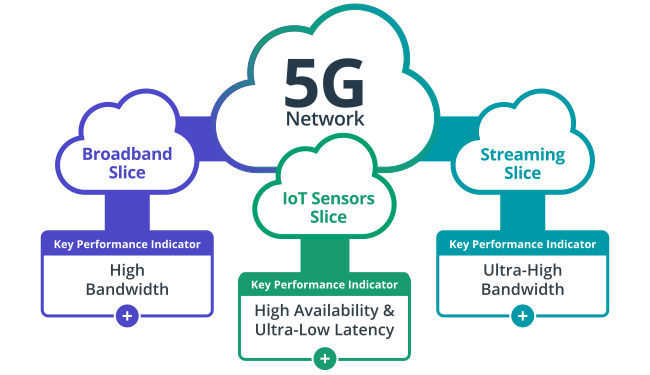
- Network Slicing Complexity: 5G allows for multiple virtual networks (slices) to run on a single physical infrastructure, each tailored for specific service requirements (e.g., enhanced mobile broadband, ultra-reliable low-latency communications, massive machine-type communications). Monitoring each slice's performance independently, while also understanding their cumulative impact on the underlying infrastructure, is a significant challenge.
- Ultra-Low Latency Demands: Applications like autonomous vehicles, remote surgery, and industrial automation rely on low latency. Any deviation from expected latency can have catastrophic consequences, making real-time, microsecond-level latency monitoring paramount.
- Massive Device Connectivity: The sheer volume of connected IoT devices (massive machine-type communications, mMTC) introduces an enormous scale of data points and potential points of failure, demanding scalable monitoring solutions.
- Distributed Architecture (Edge Computing): With increasing reliance on edge computing for processing data closer to the source, monitoring extends beyond the central core to thousands of distributed edge nodes, each requiring granular performance insights.
- Dynamic Resource Allocation: 5G networks are designed to be dynamic and agile, with resources allocated on demand. This fluidity makes baseline performance difficult to establish and anomalies harder to pinpoint without intelligent, adaptive monitoring.
Impact on Business and User Experience
Poor 5G network performance directly translates to dissatisfied customers, lost revenue, and damaged brand reputation. For enterprises leveraging 5G for mission-critical operations, network failures can lead to operational paralysis. Effective 5G network performance monitoring tools are the frontline defense against these issues, ensuring:
- Consistent Service Delivery: Guarantees that services like streaming video, cloud gaming, and enterprise applications meet their promised performance levels.
- Optimized Resource Utilization: Helps operators efficiently manage and allocate network resources, reducing operational costs and maximizing infrastructure investment.
- Proactive Problem Resolution: Identifies potential issues before they impact users, enabling swift intervention and minimizing downtime.
- Enhanced Customer Satisfaction: Delivers a seamless and reliable user experience, fostering loyalty and reducing churn.
- New Revenue Stream Enablement: Provides the assurance needed to support high-value 5G use cases, such as industrial IoT, smart cities, and augmented reality, which demand guaranteed performance.
Core Capabilities of Effective 5G Monitoring Tools
Modern 5G network performance monitoring tools are sophisticated platforms that go far beyond simple ping tests. They integrate multiple data sources, leverage advanced analytics, and provide a holistic view of network health. Here are the fundamental capabilities you should expect:
Real-time Data Collection and Analysis
The ability to collect vast amounts of data from every part of the network – from the Radio Access Network (RAN) to the transport and core network – in real-time is foundational. This includes performance metrics (e.g., throughput optimization, latency, jitter, packet loss), configuration data, alarm logs, and subscriber data. Advanced network analytics engines then process this data to derive actionable insights, identifying trends, anomalies, and potential bottlenecks.
End-to-End Visibility
A true 5G monitoring solution provides a comprehensive, end-to-end view of the network. This means not just individual network elements, but the entire service chain across physical, virtual, and cloud-native domains. This holistic perspective is crucial for understanding how issues in one part of the network might impact services elsewhere, especially within complex network slicing environments. Tools should offer dashboards that visualize the entire service delivery path, highlighting critical KPIs (Key Performance Indicators) and KQIs (Key Quality Indicators).
Predictive Analytics and AI/ML Integration
The sheer volume and velocity of 5G data make manual analysis impossible. Leading 5G network performance monitoring tools incorporate Artificial Intelligence (AI) and Machine Learning (ML) algorithms. These capabilities enable:
- Automated Anomaly Detection: AI can learn normal network behavior and automatically flag deviations that indicate potential problems, often before human operators notice.
- Root Cause Analysis: ML algorithms can correlate events across different network domains to quickly pinpoint the precise cause of an issue, drastically reducing troubleshooting time.
- Predictive Analytics: By analyzing historical data and current trends, AI can forecast future network performance, anticipating capacity needs or potential failures. This allows for proactive maintenance and resource allocation.
Anomaly Detection and Root Cause Analysis
Beyond simply collecting data, effective tools excel at identifying unusual patterns or deviations from baselines. When an anomaly is detected, the system should automatically trigger alerts and, ideally, initiate an automated root cause analysis. This involves tracing the anomaly back to its origin, whether it's a misconfigured device, a congested link, or a software bug. This capability is vital for maintaining high service assurance levels.
Security and Compliance Monitoring
As 5G networks become the backbone for critical national infrastructure and sensitive enterprise data, security monitoring becomes paramount. Tools should monitor for unusual traffic patterns, unauthorized access attempts, and compliance with regulatory standards. Integration with security information and event management (SIEM) systems is often a key feature.
Key Categories of 5G Performance Monitoring Tools
The market offers a diverse range of 5G network performance monitoring tools, each specializing in different aspects of the network. A comprehensive strategy often involves integrating several of these categories:
Network Performance Management (NPM) Solutions
NPM tools are the backbone of network operations. They continuously monitor the performance of network devices, links, and services. For 5G, these tools have evolved to handle the virtualized and cloud-native aspects, offering visibility into virtual network functions (VNFs), containers, and microservices. They track KPIs like bandwidth utilization, latency, packet loss, and error rates across the entire infrastructure. Look for NPM solutions that can seamlessly integrate with 5G deployment strategies and provide a unified dashboard.
Service Assurance Platforms
While NPM focuses on network elements, service assurance platforms take a service-centric view. They monitor the end-to-end delivery of specific services (e.g., voice, video, IoT connectivity, enterprise VPNs) and measure their compliance with SLAs (Service Level Agreements). These platforms often use synthetic transactions or active probes to simulate user behavior and measure actual Quality of Experience (QoE). They are crucial for ensuring that the promise of network slicing translates into tangible service quality for customers.
Packet Capture and Protocol Analyzers
For deep-dive troubleshooting and forensic analysis, packet capture and protocol analyzers are indispensable. These tools intercept and decode network traffic, allowing engineers to inspect individual packets and understand exactly what is happening on the wire. In a 5G environment, where encrypted traffic and new protocols are common, advanced decryption and protocol decoding capabilities are vital. They are particularly useful for identifying application-level performance issues or security breaches.
Drive Test and Field Measurement Tools
Before, during, and after 5G deployment, drive test tools are used to measure real-world network performance from a user's perspective. Equipped with 5G-capable devices, these tools collect data on signal strength, coverage, data speeds, and call quality in various geographic locations. They are essential for validating network planning, identifying coverage gaps, and optimizing cell site performance. These tools provide critical data for assessing real-world throughput optimization.
Synthetic Monitoring and Active Probes
Unlike passive monitoring which observes live traffic, synthetic monitoring uses active probes to simulate user traffic and interactions. These probes can be deployed at various points in the network, including the edge, to continuously test service availability, response times, and application performance. This proactive approach helps identify issues before real users are impacted, providing early warnings for potential service degradation. They are excellent for continuous validation of low latency and high throughput services.
Best Practices for Implementing 5G Monitoring Solutions
Deploying 5G network performance monitoring tools is not a one-time event but an ongoing process that requires strategic planning and continuous refinement. Here are some best practices:
Defining KPIs and KQIs
Before selecting any tool, clearly define what success looks like. Establish specific Key Performance Indicators (KPIs) for network elements (e.g., cell utilization, handover success rate, latency per hop) and Key Quality Indicators (KQIs) for end-user experience (e.g., video streaming buffer rate, voice call drop rate, application load time). These metrics will guide your monitoring strategy and tool selection. Focus on metrics that directly correlate with Quality of Service (QoS) and Quality of Experience (QoE).
Integrating Data Sources
No single tool can provide all the answers. A robust 5G monitoring strategy involves integrating data from various sources: network devices, virtualized functions, cloud platforms, subscriber databases, and even external threat intelligence feeds. Look for tools with open APIs and strong integration capabilities to build a unified view of your network's health and service assurance.
Leveraging Automation and Orchestration
The dynamic nature of 5G necessitates automation. Implement automated workflows for common tasks like alarm correlation, root cause analysis, and even self-healing actions. Orchestration platforms can manage the deployment and scaling of monitoring agents, ensuring comprehensive coverage even in highly elastic environments. This is where the power of AI/ML in network operations truly shines.
Training and Skill Development
Even the most advanced tools are only as effective as the people operating them. Invest in training your network engineers and operations teams on the intricacies of 5G architecture and the specific monitoring tools deployed. Foster a culture of continuous learning to keep pace with the rapid evolution of 5G technologies.
The Future of 5G Network Performance Monitoring
As 5G networks continue to evolve, so too will the tools designed to monitor them. The trend is towards greater autonomy, deeper intelligence, and more proactive capabilities:
AI/ML-Driven Predictive Maintenance
The reliance on predictive analytics will only grow. Future tools will not just alert to problems but will actively predict potential failures days or weeks in advance, allowing operators to perform preventative maintenance or reallocate resources before any impact on service. This will move network operations from reactive troubleshooting to proactive optimization.
Holistic Observability and Digital Twins
The concept of "observability" – understanding the internal state of a system from its external outputs – will become central. This will involve creating "digital twins" of the 5G network, virtual replicas that can be used to simulate changes, test new configurations, and predict behavior without impacting the live network. This level of insight will be critical for managing highly complex network slicing deployments.
Security Monitoring in a Sliced Network
With each network slice potentially serving a different industry or application with unique security requirements, monitoring security at the slice level will be crucial. Tools will need to provide granular security insights for each slice, ensuring isolation and compliance while identifying threats that might exploit the shared underlying infrastructure.
Frequently Asked Questions
What is the primary challenge in monitoring 5G network performance?
The primary challenge in monitoring 5G network performance lies in its inherent complexity, particularly due to the introduction of network slicing, ultra-low latency requirements, massive device connectivity, and distributed edge computing architectures. Traditional monitoring tools often lack the granular visibility and intelligence needed to track performance across these highly dynamic, virtualized, and disaggregated environments, making it difficult to ensure consistent Quality of Service (QoS) and Quality of Experience (QoE).
How do 5G network performance monitoring tools ensure low latency?
5G network performance monitoring tools ensure low latency by employing real-time data collection from all network segments, including the RAN, transport, and core. They utilize active probes and synthetic monitoring to continuously measure end-to-end and hop-by-hop latency. Advanced analytics, often powered by AI/ML, detect even microsecond deviations from expected latency thresholds, trigger immediate alerts, and perform automated root cause analysis to pinpoint and resolve issues quickly, thus maintaining the ultra-low latency required for critical applications.
Can these tools help with 5G network slicing optimization?
Absolutely. 5G network performance monitoring tools are indispensable for network slicing optimization. They provide slice-specific visibility, allowing operators to monitor the performance of each individual slice independently, ensuring that each meets its dedicated SLA for parameters like bandwidth, latency, and reliability. These tools help in dynamically allocating resources to optimize slice performance, identify inter-slice interference, and validate that the underlying shared infrastructure is supporting all slices efficiently, ultimately enhancing service assurance for diverse use cases.

0 Komentar