
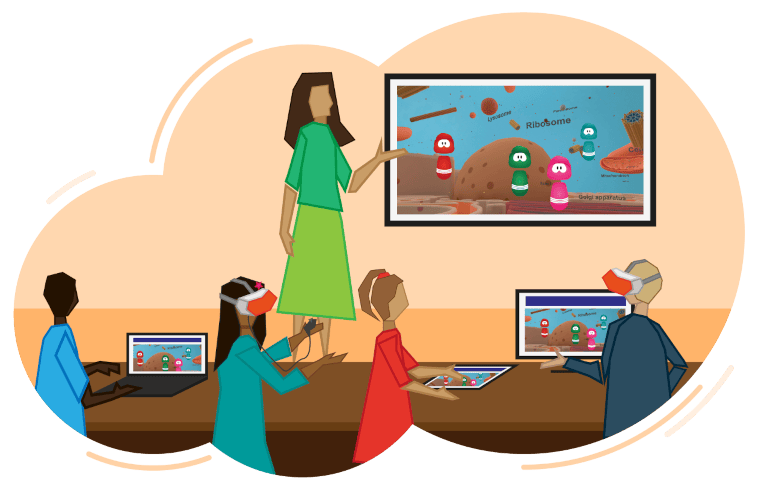
Augmented Reality for Enhancing Classroom Learning: A New Era of Immersive Education
The landscape of education is undergoing a profound transformation, moving beyond traditional textbooks and static lectures towards dynamic, interactive experiences. At the forefront of this revolution is augmented reality (AR), a groundbreaking technology that superimposes digital information onto the real world, creating an enriched, interactive environment. Imagine students exploring the human heart in 3D right on their desks, dissecting virtual frogs without a single incision, or walking through ancient Rome in their own classroom. This isn't science fiction; it's the tangible reality that augmented reality for enhancing classroom learning is making possible today, promising unparalleled levels of student engagement and deeper comprehension.
The Dawn of Immersive Learning: What is Augmented Reality in Education?
Augmented reality is a technology that overlays computer-generated images, sounds, or other data onto a user's view of the real world, providing a composite view. Unlike virtual reality (VR), which completely immerses users in a simulated environment, AR enhances the existing reality. In an educational context, this means leveraging devices like smartphones, tablets, or specialized AR headsets to bring digital content into the physical classroom. This innovative approach allows educators to present complex information in a highly visual and interactive manner, fundamentally changing how students interact with learning materials and concepts. It's a powerful form of educational technology that bridges the gap between abstract ideas and concrete understanding.
The core principle behind AR's educational efficacy lies in its ability to make learning tangible and immediate. By integrating digital layers onto physical objects or spaces, AR provides contextually relevant information precisely when and where it's needed. This capability fosters a more intuitive and exploratory learning process, moving away from rote memorization towards active discovery. For instance, a student studying geology could point their device at a rock sample and immediately see its geological composition, formation history, and even a 3D model of its crystalline structure. This immediate feedback and rich visualization are critical for developing a deeper, more lasting understanding of subjects that might otherwise seem abstract or distant.
Beyond Textbooks: How AR Transforms Pedagogical Approaches
The integration of AR into the classroom represents a significant pedagogical shift, moving away from passive information consumption towards active, experiential learning. This transition is vital for preparing students for a future that demands critical thinking, problem-solving, and digital fluency. AR's unique capabilities allow educators to design lessons that are not only informative but also incredibly compelling and memorable.
Enhancing Student Engagement and Motivation
- Interactive Exploration: AR transforms static images and text into dynamic, explorable 3D models and animations. Students are no longer just reading about a concept; they are actively manipulating and interacting with it. This hands-on approach naturally boosts student engagement, turning passive learners into active participants.
- Gamified Learning Experiences: Many AR applications incorporate elements of gamified learning, such as challenges, rewards, and interactive puzzles. This makes the learning process more enjoyable and less like traditional "work," intrinsically motivating students to delve deeper into subjects. Imagine a history lesson where students "collect" artifacts by scanning historical images, unlocking new information and progressing through a narrative.
- Novelty and Curiosity: The very novelty of augmented reality technology captures students' attention. Its ability to seemingly bring digital objects into the real world sparks curiosity and excitement, making even traditionally "dry" subjects fascinating. This initial spark can be leveraged to sustain interest over longer periods.
Visualizing Complex Concepts with Clarity
Some of the most challenging topics in subjects like science, mathematics, and engineering involve abstract concepts that are difficult to visualize. AR excels at making the invisible visible and the abstract concrete. For instance, understanding the intricate workings of the human circulatory system or the complex structure of a molecule becomes far simpler when students can view and manipulate 3D models overlaid onto their textbooks or even their own bodies. This kind of spatial computing allows students to grasp relationships and structures that are hard to convey through 2D diagrams or verbal descriptions alone.
In physics, AR can demonstrate principles like gravity or electromagnetism through real-time simulations, allowing students to see the effects of forces or fields in their immediate environment. For geometry, students can project 3D shapes into their classroom, rotate them, and explore their properties from all angles, vastly improving their spatial reasoning skills. This direct, visual interaction reduces cognitive load and accelerates comprehension, especially for visual learners.
Fostering Collaborative and Personalized Learning Experiences
- Collaborative Exploration: AR applications can facilitate group work, allowing multiple students to interact with the same augmented environment simultaneously. This promotes teamwork, discussion, and peer-to-peer learning. For example, a group of students could collectively explore an ancient ruin, each contributing to the discovery and analysis of different elements. This fosters valuable collaborative learning skills.
- Personalized Instruction: AR tools can be adapted to individual learning paces and styles. Students can revisit complex models as many times as needed, explore content at their own speed, and focus on areas where they require more reinforcement. This enables truly personalized instruction, catering to the diverse needs within a classroom and helping every student achieve mastery.
- Accessibility Enhancements: AR can also be a powerful tool for students with diverse learning needs, offering alternative ways to interact with information. For example, text can be read aloud, visuals can be manipulated for better contrast, and interactive elements can provide multi-sensory engagement, making learning more accessible and inclusive.
Practical Applications of Augmented Reality in Diverse Subjects
The versatility of augmented reality means its applications span across the entire curriculum, offering unique learning opportunities in almost every subject area.
Science and Biology: Anatomy to Astronomy
AR excels in scientific education. Students can use apps to virtually dissect a frog or a human heart, explore the internal organs of the body in 3D, or even project a rotating model of the solar system onto their classroom ceiling. Applications like "Anatomy 4D" or "Merge Explorer" allow students to interact with highly detailed anatomical models, fostering a deeper understanding of biological systems without the need for expensive and often messy physical models or dissections. Imagine holding a virtual model of a cell in your hand, zooming in to see its organelles, or manipulating DNA strands directly. This brings scientific concepts to life in an unprecedented way.
History and Social Studies: Bringing the Past to Life
History can become incredibly vivid with AR. Students can take virtual field trips to ancient civilizations, walk through historical battlefields, or witness significant historical events unfold in their own classroom. AR apps can overlay historical figures or buildings onto modern landscapes, allowing students to compare past and present. This makes historical events feel more immediate and relevant, fostering a greater appreciation for the past and its impact on the present. For instance, an AR experience could transport students to the signing of the Declaration of Independence, allowing them to virtually stand among the founding fathers.
Mathematics: Making Abstract Concepts Tangible
AR can transform abstract mathematical concepts into tangible, manipulable objects. Students can visualize geometric shapes in 3D space, explore functions and graphs interactively, or even solve complex equations by manipulating virtual elements. This helps students develop a stronger intuition for mathematical principles, moving beyond memorization to genuine understanding. For example, an AR app could project a 3D graph onto a desk, allowing students to rotate it and see how changes in variables affect its form.
Language Arts: Interactive Storytelling and Vocabulary
AR can bring stories and literature to life. Students can interact with characters that pop out of books, explore scenes from novels, or engage with interactive vocabulary builders. Imagine a student reading a classic novel and, at key moments, an AR overlay brings a scene or character to life on the page, enhancing comprehension and making reading a more dynamic experience. AR can also facilitate language acquisition by providing interactive visual cues for new words or phrases, making vocabulary learning more engaging and effective.
Arts and Design: Unleashing Creativity
In the arts, AR offers new avenues for creative expression. Students can create digital art that interacts with the physical environment, design 3D models that can be viewed in real space, or even compose music that reacts to their movements. This provides a fresh medium for artistic exploration and allows students to see their digital creations integrated into the real world, fostering a deeper understanding of design principles and spatial relationships.
Implementing AR in Your Classroom: A Step-by-Step Guide for Educators
While the potential of AR is immense, successful integration requires thoughtful planning and execution. Educators don't need to be tech wizards to start, but a structured approach is beneficial.
Choosing the Right AR Tools and Applications
- Research and Review: Begin by researching available AR apps and platforms relevant to your subject area and grade level. Look for apps with strong educational content, intuitive interfaces, and positive reviews from other educators. Consider platforms like Merge EDU, Google Arts & Culture (with AR features), or specific apps for anatomy, history, or science.
- Compatibility Check: Ensure the chosen tools are compatible with your existing classroom devices (i.e., tablets, smartphones). Some AR experiences require specific hardware or operating systems.
- Cost and Licensing: Evaluate the cost implications. Many educational AR apps offer free versions or trial periods, while others require subscriptions or one-time purchases. Consider site licenses for broader classroom use.
Integrating AR into Curriculum Design
- Define Learning Objectives: Before introducing AR, clearly identify what learning outcomes you want to achieve. How will AR enhance these objectives? Is it for visualization, interaction, problem-solving, or engagement?
- Lesson Planning: Design specific lessons where AR can genuinely add value, rather than just being a novelty. Integrate AR activities as a core part of the lesson, not just an add-on. For instance, instead of just showing a diagram of the human skeleton, have students use AR to explore each bone individually and understand its function in a 3D context.
- Scaffolding and Support: Provide clear instructions and support for students using AR for the first time. Start with simple activities and gradually introduce more complex ones. Consider creating short tutorials or quick guides.
Addressing Technical Challenges and Support
- Device Management: Ensure devices are charged and ready for use. Have a system for distributing and collecting devices if they are shared.
- Connectivity: Reliable Wi-Fi is crucial for many AR applications. Test connectivity in the classroom beforehand.
- Troubleshooting: Be prepared for common technical glitches. Familiarize yourself with basic troubleshooting steps for the AR apps and devices you are using. Often, a simple restart can resolve issues.
- Professional Development: Seek out professional development opportunities or online resources to enhance your own digital literacy and comfort with AR technology. Many educational technology conferences now feature workshops on AR integration.
Best Practices for Maximizing AR's Impact
- Start Small: Don't try to overhaul your entire curriculum at once. Begin with one or two well-planned AR lessons to gain experience and confidence.
- Clear Instructions: Always provide clear, concise instructions for AR activities. Students need to understand what they are supposed to do and what they are learning.
- Encourage Exploration: While guided activities are important, also allow time for students to freely explore AR applications. This fosters curiosity and independent learning.
- Facilitate Discussion: After AR activities, lead discussions to help students articulate what they've learned, ask questions, and connect the AR experience to broader concepts.
- Seek Feedback: Regularly solicit feedback from students on their AR experiences. What did they enjoy? What was challenging? This input can help refine future AR lessons.
Overcoming Obstacles and Ensuring Equitable Access to AR Education
While the benefits of augmented reality in education are clear, there are practical challenges that schools and educators must address to ensure equitable access and effective implementation. These challenges are not insurmountable but require strategic planning and investment.
Cost and Device Accessibility
The initial investment in AR-compatible devices (tablets, smartphones, or dedicated AR headsets) can be significant for schools with limited budgets. However, many schools are already equipped with tablets or smartphones that can run a wide range of AR applications. Strategies to mitigate costs include: leveraging existing "Bring Your Own Device" (BYOD) policies, seeking grants specifically for educational technology, or investing in a smaller set of shared devices for classroom use. Cloud-based AR solutions that require less powerful local hardware are also emerging, making the technology more accessible.
Teacher Training and Professional Development
For AR to be effectively integrated, teachers need adequate training and ongoing professional development. Many educators may feel overwhelmed by new technologies. Providing comprehensive training that covers not just the "how-to" of using AR tools but also the "why" – the pedagogical benefits and best practices – is crucial. This training should foster confidence and creativity in integrating AR into existing curricula. Collaborative learning communities among teachers can also provide peer support and shared expertise in navigating new technologies.
Content Quality and Curriculum Alignment
The proliferation of AR apps means there's a need for careful curation of high-quality educational content. Not all AR apps are created equal; some may be merely novelties without significant pedagogical value. Educators must be discerning, selecting apps that align with curriculum standards, offer accurate information, and genuinely enhance learning objectives. Collaborations between educators, content creators, and subject matter experts can help develop robust, curriculum-aligned AR learning experiences that move beyond superficial interactions.
The Future of Learning: AR's Role in Shaping Education
The trajectory of augmented reality in education points towards an increasingly integrated and sophisticated learning environment. As AR technology matures and becomes more ubiquitous, we can anticipate even more seamless and intuitive experiences. The convergence of AR with artificial intelligence (AI) holds particular promise, enabling truly intelligent tutoring systems that can adapt content in real-time based on a student's performance and learning style. This level of personalized instruction could revolutionize how students master concepts and develop skills.
Furthermore, the development of more advanced AR glasses and lightweight headsets will free students from holding devices, allowing for even more natural and immersive interactions with digital content in the physical world. This shift towards hands-free, persistent AR environments will unlock new possibilities for experiential learning, from conducting virtual chemistry experiments on a lab bench to collaboratively designing architectural structures in a shared classroom space. The concept of mixed reality, where virtual and real objects coexist and interact in real-time, will become increasingly prevalent, blurring the lines between the digital and physical learning spaces. This continuous evolution promises exciting advancements in pedagogical innovation, preparing students not just for current challenges but for a future where digital and physical realities are inextricably linked. Educators who embrace this technology will be at the forefront of shaping the next generation of learners, equipped with the critical thinking, problem-solving, and digital literacy skills essential for success in an ever-evolving world.
Frequently Asked Questions About Augmented Reality in Education
What are the primary benefits of using augmented reality for classroom learning?
The primary benefits of using augmented reality for classroom learning include significantly boosting student engagement and motivation by making learning interactive and fun. AR also excels at visualizing complex, abstract concepts in 3D, leading to deeper comprehension. It fosters personalized instruction by allowing students to learn at their own pace and explore content interactively. Additionally, AR promotes collaborative learning through shared immersive experiences and enhances digital literacy skills essential for the modern world. It transforms passive learning into active exploration and discovery.
Is augmented reality difficult for teachers to implement?
While introducing any new technology requires an initial learning curve, augmented reality implementation is becoming increasingly user-friendly. Many AR apps are designed with intuitive interfaces, making them relatively easy for teachers to pick up. The main challenges typically involve ensuring device compatibility, managing classroom technology, and integrating AR activities thoughtfully into the curriculum. With proper training, access to reliable devices, and a clear understanding of learning objectives, teachers can successfully implement AR, enhancing their teaching methods and providing richer experiences for students. Starting with simple, well-supported apps is often the best approach.
What kind of equipment is needed for AR in the classroom?
The most common and accessible equipment needed for AR in the classroom includes smartphones and tablets (iOS or Android devices) that support AR capabilities. Many modern devices come with built-in AR functionality. Some advanced AR experiences might utilize dedicated AR headsets or smart glasses, but these are less common in general education settings due to cost and availability. Additionally, a stable internet connection is often required for downloading apps and accessing cloud-based AR content. Certain AR applications may also use physical markers (like QR codes or specific images) that trigger the augmented content when viewed through a device's camera.
How does AR enhance student engagement compared to traditional methods?
AR enhances student engagement by transforming passive learning into an active, interactive experience. Unlike traditional methods that rely on static text and images, AR allows students to manipulate 3D models, explore virtual environments, and interact directly with digital content overlaid onto their real-world surroundings. This hands-on, immersive approach captures students' attention through novelty and interactivity, making learning feel more like a game or an exploration. The immediate visual feedback and the ability to "bring things to life" significantly boost curiosity and intrinsic motivation, leading to more sustained interest and deeper cognitive processing compared to simply reading or listening.
Can augmented reality cater to different learning styles?
Yes, augmented reality is highly effective in catering to diverse learning styles. For visual learners, AR provides rich 3D models and interactive simulations that make abstract concepts tangible. Auditory learners benefit from narrated explanations and interactive sound elements often embedded in AR experiences. Kinesthetic learners thrive on the ability to physically interact with virtual objects, manipulating them with their hands or moving around them to explore different perspectives. By combining visual, auditory, and interactive elements, AR offers a multi-sensory learning experience that can appeal to a broad spectrum of learning preferences, making education more inclusive and effective for all students.

0 Komentar