
Unraveling Quantum Computing Control Systems: A Deep Dive into Precision Qubit Manipulation
The promise of quantum computing hinges not just on the creation of delicate quantum bits, or qubits, but crucially on our ability to precisely manipulate and control them. Understanding quantum computing control systems explained is paramount to unlocking the full potential of this revolutionary technology. These sophisticated systems are the unsung heroes, translating classical instructions into the precise quantum operations needed to perform complex computations. Without robust and accurate control, the fragile quantum states would collapse, rendering quantum computers ineffective. This article delves deep into the intricate world of quantum control, exploring its fundamental principles, the challenges it faces, and the cutting-edge innovations driving its evolution towards fault-tolerant quantum computing.
The Foundational Pillars of Quantum Control
At its core, a quantum computing control system is the bridge between the classical world of human instructions and the quantum realm where computations occur. Its primary function is to orchestrate the delicate dance of qubit manipulation, ensuring that quantum gates are applied with extremely high fidelity. This involves generating, delivering, and precisely timing signals that alter the quantum state of individual qubits or entangled groups of them. The challenge is immense, as qubits are incredibly sensitive to their environment, making the task of maintaining quantum coherence a constant battle against noise and interference.
The Delicate Dance of Qubit Manipulation
Controlling qubits requires an exquisite level of precision, often operating on timescales of nanoseconds or even picoseconds. Different qubit modalities necessitate varied control mechanisms:
- Superconducting Qubits: Primarily controlled using precisely shaped microwave pulses. These pulses induce transitions between energy levels, effectively rotating the qubit's state on the Bloch sphere. The amplitude, phase, and duration of these pulses are critical for accurate gate operations.
- Trapped Ion Qubits: Manipulated using highly focused and stable laser beams. Specific laser frequencies can drive transitions, entangle ions, or perform cooling operations to maintain their quantum state.
- Semiconductor Quantum Dots: Often controlled via electrical voltages applied to nearby gates, which can confine and manipulate individual electrons acting as qubits. Magnetic fields can also be used for spin control.
- Topological Qubits: While still largely theoretical, their control is envisioned to be inherently robust due to their non-local nature, relying on braiding operations.
Achieving high-fidelity quantum gate operations is the ultimate goal. This means executing a gate with minimal error, ensuring the qubit ends up in the desired state. Practical advice for achieving this includes meticulous calibration of control signals, minimizing environmental noise, and employing advanced pulse shaping techniques to counteract imperfections in the control hardware.
Key Components of a Quantum Control System
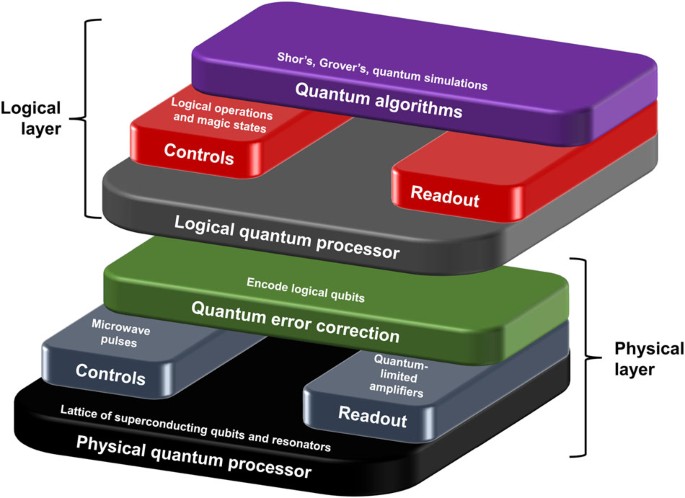
A typical quantum computing control system is a sophisticated stack of hardware and software, working in concert to translate abstract quantum algorithms into physical qubit operations. These systems are inherently complex, requiring integration across multiple layers of abstraction and technology.
From Classical Signals to Quantum Effects: The Control Stack
The journey of a quantum instruction from a high-level algorithm to a physical qubit interaction involves several critical stages:
- Quantum Software Stack: This includes the quantum programming language (e.g., Qiskit, Cirq), compilers that translate quantum circuits into native gate sets, and optimizers that reduce the number of operations required.
- Pulse-Level Control Layer: This is where the abstract quantum gates are decomposed into specific analog or digital pulse sequences. High-speed digital-to-analog converters (DACs) are crucial here for generating precise waveforms.
- Control Electronics and Signal Generation: Dedicated hardware, often custom-designed, generates and synthesizes the microwave, RF, or optical signals required to interact with the qubits. This includes arbitrary waveform generators (AWGs) and frequency synthesizers.
- Signal Delivery and Conditioning: The generated signals must be delivered to the qubits with minimal loss and noise. This often involves specialized cabling (e.g., coaxial cables for microwave, optical fibers for laser light) and cryogenic components like attenuators and filters for qubits operating at millikelvin temperatures.
- Classical-Quantum Interface: This is the point where classical control signals physically interact with the qubits, often through antennas, waveguides, or optical lenses integrated into the qubit chip or trap.
- Measurement and Readout Systems: After computation, the quantum state of the qubits must be measured. This involves dedicated low-noise amplifiers, digitizers (ADCs), and processing units to convert quantum outcomes back into classical bits.
- Real-time Feedback Loop: Increasingly, control systems incorporate real-time measurement and feedback to correct errors, adjust control parameters, or even perform active error correction.
The development of reliable and high-performance control electronics is a significant area of research. These systems must operate with extremely low latency, high bandwidth, and exceptional signal purity to ensure the fidelity of quantum operations. The integration of cryogenic systems for maintaining ultra-low temperatures, essential for many qubit types, adds another layer of engineering complexity to the overall control infrastructure.
Challenges and Innovations in Quantum Control
Despite significant progress, building practical quantum computing control systems faces formidable challenges. Overcoming these hurdles is essential for scaling up quantum computers and achieving fault-tolerant quantum computing.
Battling Decoherence: A Constant Struggle
Decoherence remains the Achilles' heel of quantum computing. It's the process by which a quantum system loses its coherence (its quantum properties) due to interaction with the environment. This loss of coherence leads to errors and limits the computation time. Control systems play a vital role in mitigating decoherence by:
- Precision Pulse Shaping: Designing control pulses that are robust against environmental noise and variations. Techniques like composite pulses or optimal control theory are employed.
- Active Error Correction: Implementing quantum error correction codes requires the control system to perform rapid, high-fidelity operations to detect and correct errors before they propagate. This demands extremely low latency and high throughput from the classical control hardware.
- Environmental Isolation: While not strictly part of the control system, the control system must function within and sometimes facilitate the extreme isolation required (e.g., deep vacuum, cryogenic temperatures, magnetic shielding).
Practical advice for researchers and engineers includes continuous characterization of qubit noise environments, iterative optimization of pulse sequences, and investing in advanced materials and engineering to improve isolation. The goal is to extend the coherence time of qubits, allowing for more complex computations before errors accumulate.
Scaling Up: The Interconnect and Architecture Problem
Current quantum computers typically have a limited number of qubits. Scaling to thousands or millions of qubits, necessary for universal fault-tolerant quantum computing, introduces massive control challenges:
- Wiring Complexity: Each qubit often requires multiple control lines. As the number of qubits increases, the physical wiring becomes unwieldy, especially in cryogenic environments. Innovations in 3D integration, through-silicon vias (TSVs), and on-chip control are critical.
- Power Dissipation: Control electronics generate heat, which is a major issue in cryogenic systems. Developing low-power cryogenic control electronics is a key research area.
- Crosstalk: Signals intended for one qubit can inadvertently affect neighboring qubits, leading to errors. Advanced control system design must minimize crosstalk through careful signal routing, shielding, and pulse design.
- Calibration and Characterization: Calibrating and characterizing a large number of qubits and their interactions becomes exponentially more complex. Automated calibration routines and machine learning techniques are essential for managing this complexity.
The move towards scalable quantum architectures often involves modular designs, where smaller quantum processors are interconnected, or the development of integrated control circuitry directly on the qubit chip. This shift is crucial for addressing the "wiring bottleneck" and enabling the construction of truly large-scale quantum computers.
Advanced Control Techniques and Future Directions
The field of quantum control is dynamic, with continuous innovation pushing the boundaries of what's possible. Researchers are exploring sophisticated techniques to enhance fidelity, speed, and scalability.
Real-Time Feedback and Adaptive Control
Traditional quantum experiments often involve open-loop control, where pre-programmed pulses are applied without immediate knowledge of the qubit state. However, for higher fidelity and error correction, real-time feedback is becoming indispensable. This involves:
- Rapid Measurement: Quickly measuring the state of a qubit.
- Fast Decision Making: Processing that measurement data in real-time.
- Adaptive Pulse Adjustment: Modifying subsequent control pulses based on the measurement outcome.
This closed-loop control allows for dynamic error correction, state preparation, and even optimization of gate parameters on the fly. For instance, if a qubit drifts slightly due to environmental noise, a real-time feedback system could detect this and apply a corrective pulse. Implementing such systems requires extremely low-latency classical processing and high-speed data transfer between the quantum processor and its control electronics.
The Role of AI and Machine Learning in Quantum Control
Artificial intelligence and machine learning (AI/ML) are emerging as powerful tools for optimizing quantum control. The complexity of calibrating and fine-tuning quantum systems, especially as they scale, is well-suited for ML algorithms:
- Automated Calibration: ML algorithms can learn optimal control parameters (e.g., pulse shapes, amplitudes, durations) much faster and more efficiently than manual methods, adapting to drift and environmental changes.
- Optimal Control Theory with ML: Combining classical optimal control techniques with machine learning can discover highly efficient and robust pulse sequences that minimize errors and maximize gate fidelity.
- Quantum Error Mitigation: ML can help in identifying and classifying different types of errors, informing the control system on how best to mitigate them.
- Adaptive Learning: Reinforcement learning agents can interact with the quantum system, iteratively adjusting control policies to achieve desired outcomes, such as preparing a specific quantum state or executing a gate with maximum fidelity.
The integration of AI/ML not only accelerates the experimental process but also promises to unlock control strategies that are too complex for human intuition alone, paving the way for more robust and powerful quantum computers.
Frequently Asked Questions
What is the primary challenge in developing quantum computing control systems?
The primary challenge in developing quantum computing control systems explained is managing the extreme fragility of qubits. Qubits are highly susceptible to decoherence, meaning they lose their quantum properties rapidly due to interactions with their environment. Control systems must deliver incredibly precise, low-noise signals at specific frequencies and timings, often at cryogenic temperatures, to manipulate these delicate states without causing errors or premature decoherence. Scaling these high-precision control mechanisms to a large number of qubits introduces further challenges related to wiring complexity, power dissipation, and crosstalk, demanding innovative engineering solutions.
How do quantum control systems ensure high fidelity of quantum operations?
Quantum control systems ensure high fidelity through a combination of meticulous engineering and advanced techniques. This includes generating ultra-pure, low-noise control signals (e.g., microwave pulses or laser beams), precise timing synchronization, and careful calibration of control parameters. Techniques like pulse shaping (e.g., DRAG pulses for superconducting qubits), dynamic decoupling, and the implementation of optimal control theory are used to design robust gate operations that minimize errors. Furthermore, the integration of real-time feedback loops allows for adaptive adjustments and active error correction, significantly boosting the reliability of quantum gate operations.
What role does cryogenic engineering play in quantum control?
Cryogenic engineering plays a crucial role in quantum control, particularly for superconducting and some semiconductor qubit architectures. Many types of qubits require extremely low temperatures, often just a few millikelvin above absolute zero, to maintain their quantum coherence and minimize thermal noise. The control system must interface with these cryogenic environments. This means that components like signal lines, filters, and sometimes even parts of the control electronics themselves must be designed to operate efficiently at these ultra-low temperatures, minimizing heat load and ensuring signal integrity. Developing cryogenic control electronics that can operate at scale without generating excessive heat is a significant area of research.
Can classical computers directly control quantum computers?
Yes, classical computers directly control quantum computers, but they do so through an intricate classical-quantum interface and specialized control systems. A classical computer running quantum software translates high-level quantum algorithms into sequences of elementary quantum gates. These gates are then further decomposed into specific physical control pulses (e.g., microwave bursts, laser pulses). The quantum computing control systems act as the intermediary, generating and delivering these precise classical signals to the quantum processor. The quantum processor executes the operations, and its quantum state is then measured, with the measurement outcomes being fed back to the classical computer for analysis or further control decisions. This highlights the symbiotic relationship where classical computing orchestrates and interprets the quantum computations.

0 Komentar