
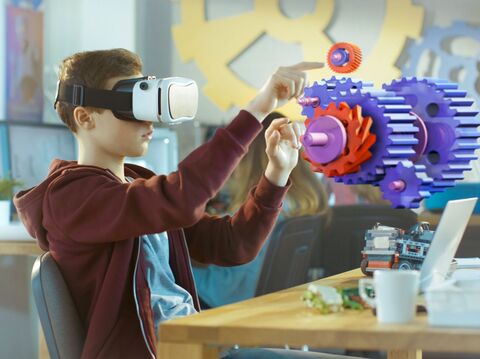
Augmented Reality for Creating Immersive Experiences: A Deep Dive into Next-Gen Interaction
In an increasingly digital world, the quest for deeper, more meaningful interactions is paramount. Augmented reality (AR) stands at the forefront of this revolution, transforming how we perceive and interact with our environment by seamlessly blending digital information with the physical world. This advanced technology is not merely about overlaying graphics; it's about crafting truly immersive experiences that engage our senses, enhance understanding, and elevate everyday interactions. From dynamic educational tools to breathtaking entertainment and critical enterprise solutions, AR is redefining the boundaries of reality, promising a future where our digital and physical lives intertwine with unprecedented fluidity.
The Transformative Power of Augmented Reality in Immersion
Immersive experiences are characterized by their ability to transport users into a state of deep engagement, where the line between the real and the simulated blurs. While virtual reality (VR) achieves this by completely enveloping the user in a digital world, augmented reality takes a different, equally powerful approach. AR enhances the existing physical environment, adding layers of digital content that are contextually relevant and interactive. This unique capability makes AR an incredibly potent tool for creating experiences that feel natural, intuitive, and deeply integrated into our lives.
Defining Immersive Experiences with AR
An truly immersive AR experience goes beyond simple visual overlays. It involves:
- Spatial Awareness: The digital content intelligently understands and interacts with the physical space.
- Real-Time Interaction: Users can manipulate or engage with digital elements instantly, often through gestures, voice commands, or touch.
- Sensory Engagement: While primarily visual, advanced AR can incorporate auditory cues, and even haptic feedback to provide a more holistic sensory experience.
- Contextual Relevance: The overlaid information is meaningful and useful in the specific physical location or situation.
Beyond the Screen: Blending Digital and Physical
The magic of augmented reality lies in its ability to augment reality, not replace it. This means users remain connected to their physical surroundings, allowing for social interaction, navigation, and practical application that is often limited in fully virtual environments. This blending creates a unique form of "mixed reality" or "extended reality (XR)," where digital objects appear to coexist within the user's physical space, offering unparalleled opportunities for interactive experiences that are both intuitive and deeply engaging.
Key Technologies Powering AR Immersion
The sophistication of modern augmented reality solutions is a testament to rapid advancements in several key technological domains. These innovations work in concert to deliver the seamless, responsive, and truly immersive experiences users now expect.
Spatial Computing and Tracking
At the core of any compelling AR experience is robust spatial computing. This refers to the technology that allows digital content to understand and interact with the physical world. It encompasses:
- Simultaneous Localization and Mapping (SLAM): Enabling devices to map their surroundings while simultaneously tracking their own position within that map.
- Object Recognition and Tracking: Identifying and tracking specific objects, faces, or markers in the real world to anchor digital content to them.
- Depth Sensing: Using sensors (like LiDAR or Time-of-Flight cameras) to understand the distance to objects, allowing digital objects to realistically occlude or interact with real-world elements.
Advanced Display Technologies: Smart Glasses and Mobile AR
The method of delivery significantly impacts immersion. While mobile AR (via smartphones and tablets) has democratized access to augmented reality, offering a convenient entry point, true immersion often hinges on dedicated AR hardware. Smart glasses and head-mounted displays (HMDs) are designed to provide a wider field of view, more stable digital overlays, and often hands-free interaction. These devices are rapidly evolving, promising lighter, more aesthetically pleasing designs with improved optical clarity and processing power.
Real-time Rendering and 3D Models
For digital content to feel truly present, it must be rendered with high fidelity and in real-time. This requires powerful graphics processing units (GPUs) and optimized software frameworks. The quality of 3D models, textures, and lighting effects directly contributes to how believable and engaging the augmented reality experience becomes. Developers often leverage game engines like Unity and Unreal Engine to achieve photorealistic rendering and complex interactions.
Sensory Engagement and Haptic Feedback
Beyond sight and sound, the sense of touch plays a vital role in immersion. Haptic feedback, delivered through vibrations or specialized haptic devices, can simulate texture, resistance, or impact, making digital objects feel more tangible. While still an emerging area for AR, the integration of advanced sensory engagement elements promises to significantly deepen the user's connection to the augmented world.
Crafting Unforgettable Immersive AR Experiences
Developing compelling augmented reality experiences requires more than just technical prowess; it demands a deep understanding of user psychology, design principles, and storytelling. The goal is to create a seamless blend where the digital enhancements feel like a natural extension of reality.
User-Centric Design Principles for AR
- Understanding User Needs and Context: Before designing, thoroughly research the target audience and the environments in which the AR will be used. Is it for a museum tour, a surgical procedure, or a gaming session? Context dictates design.
- Intuitive User Interface (UI) and User Experience (UX): AR interfaces should be simple, natural, and non-intrusive. Avoid cluttering the user's view. Interactions should feel intuitive, often leveraging natural gestures, gaze, or voice commands rather than traditional screen taps. A well-designed user experience (UX) ensures that the technology fades into the background, allowing the user to focus on the experience itself.
- Seamless Integration with the Physical World: Digital content must respect and interact realistically with the physical environment. This includes accurate scaling, realistic lighting that matches the real world, and proper occlusion (digital objects appearing behind physical ones).
The Role of Content Creation and Storytelling
- Developing Compelling Narratives: Even for practical applications, a narrative thread can significantly enhance engagement. For entertainment, a strong story is paramount. AR offers unique storytelling opportunities by allowing users to physically move through and interact with the narrative space.
- High-Quality Digital Overlay and Assets: The visual fidelity of the digital content is critical. Low-resolution models or poorly animated characters can break immersion instantly. Investing in high-quality digital overlay assets, textures, and animations is crucial.
- Personalization and Adaptability: The ability to personalize the experience based on user preferences, location, or even emotional state can greatly increase immersion. Adaptive content that responds to changes in the physical environment or user behavior feels more alive and engaging.
Applications of Immersive AR Across Industries
The potential for augmented reality for creating immersive experiences spans nearly every sector, revolutionizing how we learn, work, shop, and play.
Entertainment and Gaming: Redefining Play
From augmented reality games like Pokémon GO that turn city streets into playgrounds, to interactive museum exhibits that bring history to life, AR is transforming entertainment. Imagine attending a live concert where virtual dragons fly over the stage, or exploring a fictional world overlaid onto your living room, with characters interacting with your furniture. The possibilities for interactive experiences are boundless.
Retail and E-commerce: Virtual Try-Ons and Product Visualization
AR is revolutionizing the retail sector by enabling virtual try-ons for clothing, makeup, and accessories, reducing returns and enhancing customer confidence. Furniture retailers allow customers to visualize how a sofa would look in their living room before buying. This use of digital twins – virtual replicas of physical products – provides an unparalleled level of product exploration and immersion for online shoppers, bridging the gap between digital browsing and physical experience.
Education and Training: Experiential Learning
Immersive AR offers a powerful platform for experiential learning. Students can dissect virtual organs, explore ancient ruins from their classroom, or conduct complex science experiments without costly equipment. For vocational training, AR overlays can guide technicians through intricate repair procedures, providing real-time instructions and visual aids. This hands-on, interactive approach significantly improves retention and understanding, making learning more engaging and accessible.
Healthcare and Medicine: Precision and Training
In healthcare, AR is used for surgical planning, allowing surgeons to visualize patient anatomy as a digital overlay during procedures. It assists nurses in locating veins for injections and provides medical students with immersive training simulations. The ability to overlay critical patient data or anatomical structures onto the real world enhances precision and reduces errors, ultimately improving patient outcomes.
Industrial and Enterprise Solutions: Efficiency and Collaboration
For enterprise solutions, AR is boosting productivity and safety. Field technicians can receive remote assistance from experts who can draw instructions directly onto their field of view. Manufacturing plants use AR to guide assembly workers, reducing errors and training time. Digital twins of machinery can be overlaid onto physical equipment for maintenance, diagnostics, and performance monitoring, leading to significant operational efficiencies.
Overcoming Challenges and Future Prospects
While the promise of immersive AR is immense, challenges remain. These include improving hardware form factors (making smart glasses lighter and more socially acceptable), enhancing battery life, ensuring robust connectivity, and developing more sophisticated content creation tools. Furthermore, ethical considerations around data privacy, spatial mapping, and potential digital distraction need careful consideration as the technology becomes more pervasive.
However, the trajectory is clear: the future of extended reality (XR), driven significantly by advances in augmented reality, points towards a world where digital information is seamlessly integrated into our daily lives, enhancing our perception and interaction with the world around us. As processing power increases and 5G networks become ubiquitous, truly immersive and persistent AR experiences will become commonplace, transforming everything from personal communication to global commerce.
Actionable Tips for Developing Immersive AR Experiences
For businesses and developers looking to harness the power of augmented reality for creating truly compelling experiences, consider these practical tips:
- Focus on Real-World Context: Design your AR experience to complement, not distract from, the user's physical environment. The digital content should feel like a natural extension of reality, adding value to the real-world context.
- Prioritize Performance and Optimization: Lagging visuals or unresponsive interactions instantly break immersion. Optimize 3D models, textures, and code for smooth, real-time performance on target devices. This is crucial for a fluid user experience (UX).
- Iterate Based on User Feedback: User testing is vital. Observe how users interact with your AR application in various real-world scenarios. Use their feedback to refine the user interface (UI), improve tracking, and enhance content relevance.
- Integrate Multisensory Elements: Don't limit yourself to visuals. Incorporate spatial audio, and explore the potential of haptic feedback to create a richer, more engaging sensory engagement.
- Consider Scalability: Plan for how your AR experience might evolve. Can new content be easily added? Can it adapt to different devices or larger user bases? Building with scalability in mind ensures longevity and future relevance for your augmented reality solution.
Frequently Asked Questions About Immersive AR
What is the difference between Augmented Reality (AR) and Virtual Reality (VR) in creating immersive experiences?
The primary difference lies in how they handle the user's perception of reality. Augmented Reality (AR) overlays digital information onto the real world, enhancing it while keeping the user present in their physical surroundings. Think of digital objects appearing on your coffee table. Virtual Reality (VR), on the other hand, completely replaces the user's view with a simulated digital environment, transporting them to an entirely new world. While both create immersive experiences, AR blends realities, whereas VR creates a new, separate one. This distinction makes AR particularly powerful for applications requiring real-time interaction with the physical environment.
How does spatial computing contribute to immersive AR?
Spatial computing is the foundational technology that allows AR systems to understand and interact with the three-dimensional physical world. It involves technologies like SLAM (Simultaneous Localization and Mapping), depth sensing, and object recognition. Without robust spatial computing, digital content would simply float on screen without understanding its context in the real world. It enables digital objects to appear anchored in space, interact realistically with physical surfaces, and be occluded by real-world objects, all of which are critical for achieving a truly immersive and believable augmented reality experience.
What are some common challenges in developing highly immersive AR applications?
Developing highly immersive AR applications presents several challenges. Key among these are: 1. Technical Limitations: Ensuring stable tracking, realistic rendering of 3D models, and low latency on diverse hardware. 2. Hardware Constraints: Current smart glasses often have limited fields of view, battery life, and processing power. 3. Content Creation: Producing high-quality, performant digital overlay assets that seamlessly integrate with the real world is resource-intensive. 4. User Experience (UX) Design: Crafting intuitive user interface (UI) and interaction paradigms that feel natural and non-intrusive in a mixed-reality environment. 5. Data Privacy and Ethical Concerns: Addressing issues related to scanning and mapping real-world environments and user data.
Can small businesses leverage augmented reality for immersive marketing?
Absolutely. While developing complex, custom AR applications can be costly, small businesses can leverage existing platforms and tools to create engaging mobile AR experiences for marketing. Examples include AR filters for social media (e.g., Instagram, Snapchat) for virtual try-ons or interactive promotions, QR code-triggered AR experiences for product packaging, or using AR apps to visualize products in a customer's home. These accessible options allow small businesses to offer unique, immersive interactive experiences that capture attention and differentiate their brand without requiring massive investment in proprietary enterprise solutions.
What hardware is essential for truly immersive augmented reality experiences?
For truly immersive augmented reality experiences, dedicated hardware beyond standard smartphones is increasingly becoming essential. While mobile AR provides a good starting point, devices like smart glasses (e.g., Microsoft HoloLens, Magic Leap) and other head-mounted displays offer superior immersion. These devices typically feature advanced sensors for spatial computing, high-resolution transparent displays for seamless digital overlay, and dedicated processors for real-time rendering. As wearable tech continues to evolve, these purpose-built AR devices will become lighter, more powerful, and more accessible, driving the next wave of immersive AR adoption.

0 Komentar