
Unlocking 5G's Full Potential: Essential Transport Network Requirements and Solutions
The promise of 5G extends far beyond faster mobile internet; it envisions a truly connected society, enabling everything from smart cities and autonomous vehicles to immersive virtual reality and advanced industrial automation. However, realizing this transformative vision hinges critically on the underlying 5G transport network. This isn't merely an upgrade; it's a fundamental reimagining of the entire network backbone, demanding unprecedented levels of performance, flexibility, and intelligence. Understanding the intricate 5G transport network requirements and solutions is paramount for telecommunication operators, enterprises, and technology providers looking to capitalize on the next generation of connectivity. This comprehensive guide delves into the core demands placed upon the transport layer and explores the innovative solutions being deployed to build resilient, high-capacity, and future-proof 5G infrastructure.
The Imperative for a Transformed 5G Transport Network
Unlike its predecessors, 5G is designed to support a diverse range of services, each with unique performance demands. This divergence from a single-service network paradigm (primarily mobile broadband) presents significant challenges for the transport layer. The traditional, static network architectures of 4G are simply insufficient to handle the dynamic, diverse, and distributed nature of 5G traffic. The sheer volume of data, the ultra-low latency requirements for mission-critical applications, and the need for massive connectivity for IoT devices necessitate a radical overhaul of how data is moved from the radio access network (RAN) to the core network and vice versa. This transformation is not just about speed; it's about agility, intelligence, and a fundamental shift towards a service-aware network.
Core Requirements of 5G Transport Networks
The foundation of a robust 5G ecosystem lies in a transport network capable of meeting stringent performance metrics. These requirements are multifaceted, touching upon capacity, latency, flexibility, security, and operational efficiency.
Unprecedented Bandwidth and Capacity
One of the most immediate and obvious requirements for 5G transport is the need for dramatically increased bandwidth. Enhanced Mobile Broadband (eMBB) applications, such as 4K/8K video streaming, virtual reality (VR), and augmented reality (AR), generate enormous data volumes. Technologies like massive MIMO and millimeter wave (mmWave), while boosting air interface capacity, push more data into the transport network, demanding multi-gigabit and even terabit per second capabilities. The transport network must be able to aggregate and backhaul this immense traffic from thousands of small cells and macro sites without becoming a bottleneck. This necessitates pervasive deployment of high-capacity fiber optics and advanced wireless backhaul solutions.
Ultra-Low Latency and High Reliability
Beyond sheer speed, 5G introduces the stringent requirement for ultra-reliable low-latency communication (URLLC). Applications like autonomous driving, remote surgery, industrial automation, and smart grid control cannot tolerate delays measured in hundreds of milliseconds. The 5G transport network must support end-to-end latencies as low as 1 millisecond. This demands a complete re-evaluation of network architecture, pushing processing closer to the edge and minimizing hops. High reliability is equally critical, as service interruptions could have severe consequences for URLLC applications. Redundancy, resilient routing protocols, and rapid fault recovery mechanisms are essential.
Flexible and Scalable Architecture
The ability to dynamically adapt to diverse service requirements is a hallmark of 5G. This is largely enabled by network slicing, where virtual, isolated network slices are provisioned to meet specific service level agreements (SLAs) for different applications. The transport network must be slice-aware, capable of segmenting resources and guaranteeing performance for each slice. This demands a programmable and automated infrastructure, moving away from static, hardware-centric designs. Technologies like Software-Defined Networking (SDN) and Network Functions Virtualization (NFV) are crucial here, enabling dynamic resource allocation, rapid service provisioning, and agile network management.
Enhanced Security and Resilience
As 5G networks become the backbone for critical national infrastructure and sensitive data, robust security becomes non-negotiable. The distributed nature of 5G, with more edge devices and open interfaces (like Open RAN), expands the attack surface. The transport network must incorporate end-to-end encryption, strong authentication mechanisms, intrusion detection systems, and proactive threat intelligence. Furthermore, resilience against cyberattacks and physical disruptions is vital, requiring sophisticated network monitoring and self-healing capabilities.
Energy Efficiency and Cost Optimization
Deploying a ubiquitous 5G network is a massive undertaking, both in terms of capital expenditure (CAPEX) and operational expenditure (OPEX). The transport network must be designed for maximum energy efficiency to reduce power consumption and carbon footprint, especially with the proliferation of new sites. Cost optimization through automation, virtualization, and the use of open, disaggregated hardware is also a key requirement for sustainable 5G rollouts.
Key Segments of the 5G Transport Network
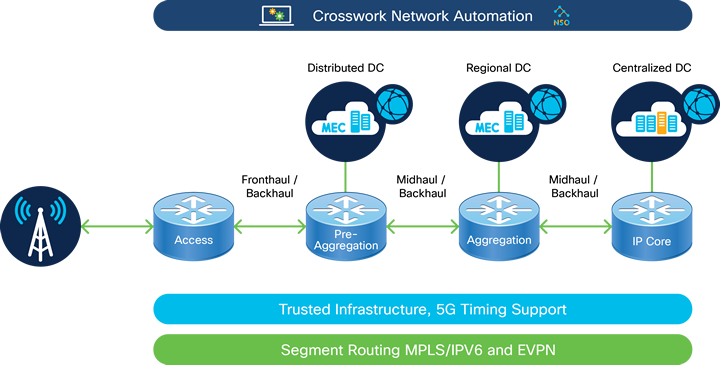
The 5G transport network is typically segmented into three primary domains, each with distinct requirements and challenges:
Fronthaul Evolution
The fronthaul connects the baseband unit (BBU) to the remote radio unit (RRU). In 4G, this was primarily based on the Common Public Radio Interface (CPRI), which required high-capacity, dedicated fiber connections and led to centralized BBU hotels. For 5G, the fronthaul is evolving to eCPRI (enhanced CPRI), which is more efficient and flexible. The shift towards Cloud-RAN (C-RAN) and subsequently Distributed-RAN (D-RAN) architectures impacts fronthaul design significantly. With C-RAN, BBUs are centralized, requiring very high-capacity, ultra-low latency links. D-RAN, conversely, distributes processing closer to the edge, reducing fronthaul demands but increasing midhaul requirements. This segmentation necessitates flexible transport solutions that can handle varying levels of functional split between the radio and baseband units.
Midhaul Integration
The midhaul segment is a new concept introduced with 5G's flexible functional splits. It connects the Distributed Unit (DU) to the Centralized Unit (CU). This segment bridges the gap between the fronthaul and backhaul, requiring a balance of bandwidth and latency capabilities. As network functions are disaggregated and virtualized, the midhaul becomes crucial for efficiently moving traffic between these distributed components. It needs to support dynamic routing and traffic steering based on network slice requirements and real-time traffic conditions.
Backhaul Modernization
The backhaul connects the central unit (CU) and edge data centers to the core network. This segment traditionally carries aggregated traffic from multiple cell sites. For 5G, backhaul capacity demands skyrocket, often requiring 100Gbps or even 400Gbps links from aggregation points to the core. Fiber optic infrastructure remains the gold standard for high-capacity backhaul, but advanced microwave solutions are also playing a crucial role, especially in areas where fiber deployment is challenging or costly. The backhaul must also be capable of supporting network slicing and providing the necessary QoS for diverse 5G services.
Innovative Solutions for 5G Transport Network Deployment
Meeting the rigorous demands of 5G transport requires a multi-pronged approach, leveraging both established and emerging technologies.
Fiber Optic Dominance
For high-capacity, low-latency requirements, fiber optic infrastructure is indispensable. Dense Wave Division Multiplexing (DWDM) and Passive Optical Networks (PON) are key technologies enabling massive bandwidth over single fiber strands. Deploying fiber deep into the network, closer to the cell sites, is a foundational step for 5G backhaul and increasingly for fronthaul. While costly and time-consuming to deploy, fiber provides the most future-proof and scalable solution.
Advanced Microwave Solutions
Where fiber deployment is impractical or uneconomical, advanced microwave systems offer a viable alternative. Modern microwave radio technology, including E-band (70-80 GHz) and V-band (60 GHz) solutions, can deliver multi-gigabit per second capacities, approaching fiber-like performance over shorter distances. These solutions are quicker to deploy and can provide crucial capacity for urban small cells and rural deployments. Innovations in spectral efficiency and interference mitigation are continually enhancing their capabilities.
Software-Defined Networking (SDN) and Network Functions Virtualization (NFV)
SDN and NFV are foundational for the agility and programmability required by 5G. SDN separates the network's control plane from the data plane, allowing for centralized, software-based control over network resources. NFV virtualizes network functions (e.g., firewalls, routers, load balancers) from proprietary hardware into software running on commodity servers. Together, they enable:
- Dynamic Resource Allocation: Resources can be provisioned and adjusted on-demand.
- Network Slicing: Virtual network slices can be created and managed end-to-end.
- Automated Provisioning: Services can be deployed rapidly and efficiently.
- Reduced CAPEX and OPEX: By using standard hardware and automating operations.
Edge Computing Integration
To achieve ultra-low latency, processing capabilities must be moved closer to the end-users and devices. Edge computing involves deploying mini data centers at the network edge (e.g., at cell sites, central offices, or enterprise premises). By processing data locally, the need to send all traffic to a distant core data center is reduced, significantly cutting down latency and backhaul traffic. Edge computing is vital for URLLC applications and real-time data analytics, transforming the transport network from a mere pipe to an intelligent, distributed processing fabric.
Network Automation and AI/ML
The complexity of 5G networks, with their distributed architecture, dynamic slicing, and massive number of connected devices, makes manual management unsustainable. Network automation, powered by Artificial Intelligence (AI) and Machine Learning (ML), is essential for efficient operation. AI/ML can be used for:
- Predictive Maintenance: Identifying potential issues before they cause outages.
- Self-Healing Networks: Automatically rerouting traffic around failures.
- Dynamic Optimization: Adjusting network resources in real-time based on traffic patterns and service demands.
- Automated Service Provisioning: Rapidly deploying and decommissioning network slices.
Open RAN Architectures
While primarily impacting the RAN, Open RAN (Open Radio Access Network) also has implications for the transport network. By disaggregating hardware and software components and promoting open interfaces, Open RAN fosters vendor diversity and innovation. This can lead to more flexible and cost-effective transport solutions, as operators are no longer locked into proprietary vendor ecosystems. The transport network must be capable of supporting the diverse interfaces and functional splits that Open RAN enables.
Practical Implementation Strategies and Best Practices
Deploying a successful 5G transport network requires careful planning and strategic execution. Here are some actionable tips:
- Assess Current Infrastructure and Future Needs: Conduct a thorough audit of your existing transport network. Identify bottlenecks, aging equipment, and areas lacking fiber density. Project future traffic growth and latency requirements based on your 5G service roadmap. This will inform your investment priorities.
- Adopt a Phased Rollout Approach: Instead of a 'big bang' deployment, consider a phased strategy. Start with high-demand urban areas or specific enterprise use cases. This allows for learning, optimization, and efficient resource allocation. Prioritize fiber upgrades where immediate capacity and latency demands are highest.
- Invest Heavily in Automation Tools: Manual configuration and troubleshooting are unsustainable. Implement SDN/NFV orchestrators, AI-driven network management systems, and robust analytics platforms from the outset. Automation is key to managing complexity, reducing OPEX, and enabling true network slicing.
- Prioritize Security at Every Layer: Security must be designed into the 5G transport network from the ground up, not as an afterthought. Implement strong authentication, encryption, and segmentation across all network segments (fronthaul, midhaul, backhaul). Regularly audit and update security protocols.
- Foster Collaboration and Ecosystem Partnerships: No single vendor or operator can build the entire 5G ecosystem alone. Collaborate with technology partners for specialized solutions (e.g., millimeter wave experts, software vendors). Consider joint ventures for fiber deployment or shared infrastructure models to optimize costs. Explore industry forums like the O-RAN Alliance for best practices.
- Embrace a Cloud-Native Mindset: Design your transport network with cloud principles in mind. This means favoring virtualization, containerization, and microservices architectures wherever possible. This approach enhances scalability, resilience, and operational efficiency, preparing the network for future evolutions beyond 5G.
Frequently Asked Questions
What are the key differences in transport for 4G vs. 5G?
The primary differences lie in capacity, latency, and flexibility. 4G transport primarily focused on aggregating mobile broadband traffic, often with centralized baseband units and less stringent latency requirements. 5G transport network, however, demands significantly higher bandwidth (up to terabits per second), ultra-low latency (1ms), and extreme flexibility to support diverse services like eMBB, URLLC, and mMTC through network slicing. It also features new segments like midhaul and pushes processing closer to the edge with edge computing, transforming the network from a simple pipe to an intelligent, distributed platform.
How does network slicing impact 5G transport?
Network slicing allows operators to create multiple virtual, isolated networks on a common physical infrastructure, each tailored to specific service requirements (e.g., a slice for autonomous vehicles with URLLC, another for IoT with mMTC). This directly impacts the 5G transport network by requiring it to be slice-aware, capable of dynamically allocating and guaranteeing resources for each slice. It necessitates a programmable infrastructure, often leveraging SDN/NFV, to ensure isolation, QoS, and security for diverse traffic types, making the transport layer highly dynamic and service-centric.
What role does edge computing play in 5G transport?
Edge computing is crucial for meeting 5G's ultra-low latency requirements. By deploying computing and storage resources closer to the end-users and devices (at the network edge), data can be processed locally, reducing the need to send all traffic to a centralized cloud. This significantly minimizes latency for real-time applications and reduces backhaul traffic. The 5G transport network becomes a distributed intelligence platform, facilitating local data processing and enabling new services that rely on instantaneous responses.
What are the main challenges in deploying 5G transport networks?
Deploying 5G transport networks faces several significant challenges. These include the massive capital expenditure (CAPEX) required for pervasive fiber deployment, especially for fronthaul and high-capacity backhaul; the complexity of integrating diverse technologies like fiber, advanced microwave, SDN/NFV, and edge computing; ensuring end-to-end security in a more distributed environment; managing the operational complexity of a highly dynamic and automated network; and addressing energy consumption concerns associated with increased network density and capacity.
How can operators ensure security in 5G transport?
Ensuring security in 5G transport networks requires a multi-layered, end-to-end approach. Key strategies include implementing robust encryption protocols across all segments (fronthaul, midhaul, backhaul), deploying strong authentication mechanisms for all network elements and users, segmenting the network to contain breaches (e.g., through network slicing), utilizing advanced threat detection and intrusion prevention systems, and leveraging AI/ML for anomaly detection and automated response. Regular security audits, compliance with industry standards, and a focus on supply chain security are also critical.

0 Komentar