
The Ultimate Guide to the Best Cloud Platforms for Machine Learning and Data Science
In today's data-driven world, selecting the best cloud platforms for machine learning and data science is a critical decision for businesses and individual practitioners alike. As the demand for advanced analytics and artificial intelligence solutions skyrockets, leveraging scalable, powerful, and cost-effective infrastructure becomes paramount. This comprehensive guide delves deep into the leading cloud offerings, helping you navigate the complex landscape to find the perfect environment for your predictive models, big data analytics, and innovative AI applications. We'll explore the core capabilities, unique strengths, and practical considerations that empower data scientists and ML engineers to build, train, and deploy models with unparalleled efficiency and speed.
Why Cloud Platforms are Indispensable for ML & Data Science
The traditional on-premise infrastructure often struggles to keep pace with the dynamic and resource-intensive demands of modern machine learning and data science workloads. Cloud platforms offer a transformative solution, providing unparalleled scalability, flexibility, and access to cutting-edge technologies. They eliminate the need for significant upfront hardware investments and ongoing maintenance, allowing teams to focus purely on innovation.
Key Advantages of Cloud for Data Professionals
- Elastic Compute Resources: Easily scale up or down CPU, GPU, and even TPU resources on demand, ensuring optimal performance for training large models without over-provisioning. This dynamic allocation is crucial for managing fluctuating workloads.
- Managed Services: Cloud providers offer fully managed services for databases, data warehousing, notebook environments, and even entire ML pipelines (MLOps), significantly reducing operational overhead and accelerating development cycles.
- Access to Specialized Hardware: Gain instant access to powerful GPUs and TPUs, which are essential for deep learning tasks, without the prohibitive cost and complexity of purchasing and maintaining such hardware.
- Global Collaboration & Accessibility: Cloud environments facilitate seamless collaboration among distributed teams, enabling data scientists and engineers to work on projects from anywhere in the world, fostering innovation and efficiency.
- Cost-Efficiency: While often perceived as expensive, cloud platforms offer various pricing models (pay-as-you-go, reserved instances, spot instances) that can lead to significant cost optimization when managed effectively, especially for bursty workloads.
- Robust Data Storage Solutions: Cloud providers offer diverse storage options, from object storage (like S3) for massive data lakes to high-performance block storage, ensuring your data is always accessible and secure.
Essential Features to Look For in a Cloud ML/DS Platform
When evaluating the best cloud platforms for machine learning and data science, it's crucial to identify the features that directly impact your productivity, model performance, and overall project success. A robust platform goes beyond just compute power; it provides a holistic ecosystem for the entire data science lifecycle.
Core Capabilities for Robust ML Workflows
- Compute Resources & Accelerators: Look for a wide range of CPU, GPU, and potentially TPU options to match the specific needs of your models, from classical machine learning to deep learning. Support for various instance types is key.
- Data Storage & Management: The platform must offer scalable, secure, and performant data storage options, including object storage for data lakes, managed databases, and data warehousing solutions for structured data. Integration with big data analytics tools is also vital.
- Development Environments: Integrated Jupyter notebooks, support for popular IDEs, and seamless integration with version control systems (like Git) are essential for efficient code development and experimentation.
- ML Framework Support: Ensure native or strong support for popular ML frameworks such as TensorFlow, PyTorch, Scikit-learn, XGBoost, and more. Pre-configured environments can save significant setup time.
- MLOps & Model Deployment: Comprehensive MLOps capabilities, including model versioning, experiment tracking, continuous integration/continuous deployment (CI/CD) for models, and robust model deployment options (batch, real-time endpoints), are non-negotiable for productionizing ML.
- Pre-built AI Services: Access to pre-trained models and APIs for common tasks like natural language processing (NLP), computer vision, and speech recognition can accelerate development for many applications. These AI services reduce the need to train models from scratch.
- Security & Compliance: Strong security features, including data encryption at rest and in transit, identity and access management (IAM), and compliance certifications (e.g., GDPR, HIPAA), are paramount, especially when dealing with sensitive data.
- Integration Capabilities: The platform should seamlessly integrate with other services within its ecosystem and potentially with third-party tools, creating a unified and efficient workflow.
Top Cloud Platforms for Machine Learning and Data Science: A Deep Dive
The market for cloud ML/DS platforms is dominated by three major players, each offering a compelling suite of services tailored for data professionals. Understanding their unique strengths will guide your decision.
Amazon Web Services (AWS) for ML/DS
AWS is a pioneer in cloud computing and offers the most extensive and mature suite of services for machine learning and data science. Its vast ecosystem provides unparalleled flexibility and depth, though it can sometimes be overwhelming for newcomers.
- Amazon SageMaker: This is AWS's flagship ML service, offering an end-to-end platform for building, training, and deploying machine learning models. SageMaker includes managed Jupyter notebooks, built-in algorithms, automatic model tuning, and robust MLOps tools like SageMaker Pipelines and Model Monitor. Its comprehensiveness makes it a strong contender for any serious ML project.
- Scalability and Integration: AWS provides massive scalability with services like Amazon EC2 (for compute), Amazon S3 (for object storage, perfect for data lakes), Amazon Redshift (data warehousing), and AWS Glue (ETL service). These services integrate seamlessly with SageMaker, enabling complex data pipelines and large-scale data storage solutions.
- Cost Management & Flexibility: AWS offers various pricing models, including On-Demand, Reserved Instances, and Spot Instances, allowing for significant cost optimization. However, managing costs requires careful monitoring and expertise due to the sheer number of services.
- Pre-built AI Services: AWS provides a rich set of pre-trained AI services such as Amazon Rekognition (computer vision), Amazon Comprehend (NLP), Amazon Polly (text-to-speech), and Amazon Forecast (time-series forecasting), reducing development time for common AI tasks.
- Actionable Tip: For complex, enterprise-level ML initiatives requiring deep integration with existing AWS infrastructure, SageMaker is an excellent choice. Leverage SageMaker Studio for a unified development environment and explore its extensive MLOps capabilities for robust production deployments.
Google Cloud Platform (GCP) for ML/DS
Google Cloud is renowned for its strengths in data analytics and deep learning, leveraging Google's internal expertise in AI. Its platform is often praised for its ease of use, particularly for those familiar with Google's ecosystem.
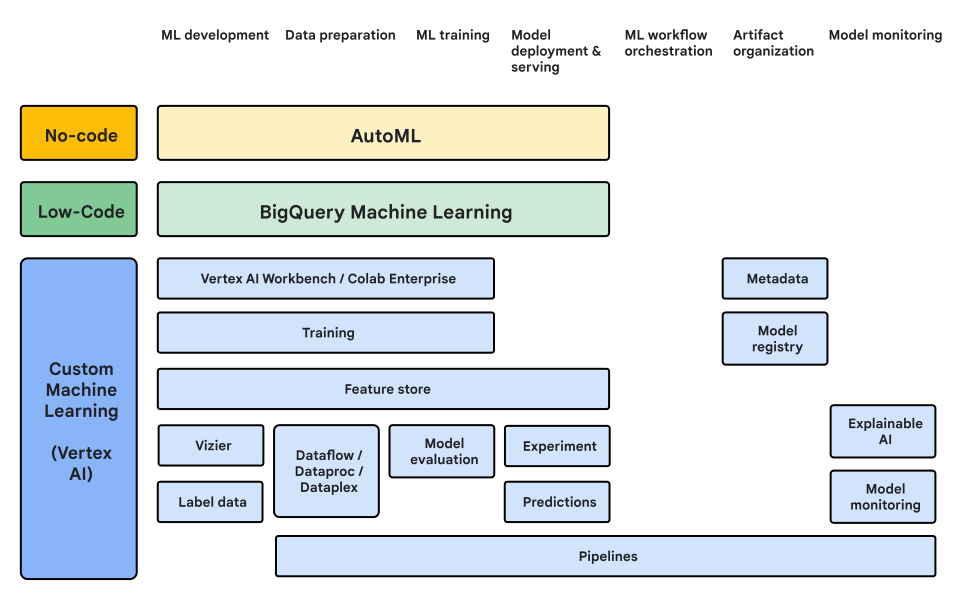
- Google Vertex AI: Launched as a unified platform, Vertex AI brings together all of Google Cloud's ML services into a single environment. This includes managed datasets, feature store, Workbench (Jupyter notebooks), training, model management, and deployment. Vertex AI aims to simplify the ML lifecycle and improve developer productivity.
- Strengths in Data Analytics: GCP shines with its powerful big data analytics services like BigQuery (a serverless, highly scalable data warehouse) and Dataflow (a fully managed service for executing Apache Beam pipelines). These tools are ideal for preparing and processing massive datasets for ML.
- Innovation and TPUs: Google is a leader in custom hardware for AI, offering Tensor Processing Units (TPUs) that provide exceptional performance for deep learning workloads, particularly those built with TensorFlow. This makes GCP a preferred choice for researchers and advanced deep learning practitioners.
- Ease of Use & Integration: GCP's services are often seen as more intuitive and well-integrated than competitors, making it easier for new users to get started. Its focus on serverless offerings further simplifies infrastructure management.
- Actionable Tip: If your organization heavily relies on big data analytics and deep learning, or if you prefer a more unified and simplified ML platform experience, GCP's Vertex AI and BigQuery combination is a powerful solution. Explore the benefits of TPUs for accelerating your deep learning model training.
Microsoft Azure for ML/DS
Microsoft Azure offers a comprehensive and integrated suite of ML and data science services, often appealing to enterprises already invested in Microsoft technologies. Azure focuses on enterprise-grade solutions, hybrid cloud capabilities, and strong integration with developer tools.
- Azure Machine Learning: This is Azure's core service for the end-to-end ML lifecycle. It provides managed notebooks, automated ML (AutoML), a designer for drag-and-drop ML, MLOps features like experiment tracking and model registries, and flexible deployment options.
- Hybrid Cloud Capabilities: Azure's strong hybrid cloud offerings, including Azure Arc, allow enterprises to extend Azure services and management to on-premises environments, providing flexibility for data governance and compliance requirements.
- Enterprise-Grade Solutions: Azure excels in providing robust security, compliance, and governance features that are crucial for large enterprises. Its integration with Microsoft's enterprise ecosystem (e.g., Active Directory, Power BI) is a significant advantage for many organizations.
- Data Platform Integration: Azure offers powerful data services like Azure Databricks (for Apache Spark-based analytics), Azure Synapse Analytics (a unified analytics service), and Azure Data Lake Storage, providing a comprehensive data foundation for ML workloads.
- Actionable Tip: For enterprises deeply embedded in the Microsoft ecosystem or those requiring robust hybrid cloud capabilities and strong governance, Azure Machine Learning provides a familiar and powerful environment. Leverage Azure Databricks for large-scale data processing and collaboration.
Choosing the Right Cloud Platform for Your ML & Data Science Needs
The "best" cloud platform isn't a one-size-fits-all answer; it depends heavily on your specific project requirements, team expertise, existing infrastructure, and budget. A thoughtful evaluation process is crucial.
Practical Considerations for Platform Selection
- Project Scope & Complexity:
- Small Projects/POCs: For quick experiments or learning, platforms with generous free tiers or simplified interfaces (like Google Colab, often backed by GCP) might be ideal.
- Large-Scale/Enterprise Solutions: Comprehensive platforms like AWS SageMaker, Google Vertex AI, or Azure ML are better suited for production-grade models, requiring extensive MLOps, robust security, and deep integration.
- Team Expertise & Learning Curve:
- Consider your team's familiarity with specific cloud ecosystems. Migrating to a completely new platform might involve a significant learning curve and training costs.
- Some platforms are perceived as more user-friendly (e.g., GCP), while others offer deeper customization for experienced users (e.g., AWS).
- Budget & Cost Optimization:
- Understand the pricing models for compute, storage, data transfer, and managed services. Utilize cost calculators and closely monitor usage.
- Explore options like spot instances for non-critical workloads, reserved instances for stable loads, and auto-scaling to prevent overspending.
- Data Governance & Compliance:
- For industries with strict regulations (healthcare, finance), ensure the chosen platform offers the necessary certifications (e.g., HIPAA, GDPR, ISO 27001) and robust data residency options.
- Evaluate the platform's security features, including encryption, access control, and network isolation.
- Ecosystem Integration:
- If your organization already uses a specific cloud provider for other services (e.g., databases, web hosting), leveraging the same ecosystem for ML/DS can simplify integration, data transfer, and management.
- Consider how easily the ML platform integrates with your existing data sources and visualization tools.
Advanced Strategies for Maximizing Cloud ML/DS Performance
Beyond simply choosing a platform, optimizing your cloud ML/DS workflows requires strategic planning and adherence to best practices. This ensures not only high performance but also efficient resource utilization.
Leveraging Managed Services for Efficiency
While Infrastructure as a Service (IaaS) provides maximum control, fully managed services often offer better efficiency and lower operational burden for ML and data science tasks. For instance, using Amazon SageMaker, Google Vertex AI, or Azure Machine Learning's managed training jobs means you don't have to provision and manage EC2 instances, virtual machines, or Kubernetes clusters yourself. The cloud provider handles patching, scaling, and maintenance, allowing your team to focus solely on model development and iteration. This is particularly beneficial for model deployment pipelines where uptime and reliability are critical.
Implementing MLOps Best Practices
MLOps (Machine Learning Operations) is crucial for moving ML models from experimentation to production reliably and efficiently. Regardless of your chosen cloud platform, adopting MLOps principles will significantly improve your workflow.
- Version Control: Treat your code, data, and models as code. Use Git for versioning all components.
- Automated Pipelines: Implement CI/CD pipelines for data preparation, model training, evaluation, and deployment. Cloud services like AWS CodePipeline, Azure DevOps, and Google Cloud Build can automate these steps.
- Experiment Tracking: Use tools (often built into the cloud ML platforms) to log parameters, metrics, and artifacts for each experiment, enabling reproducibility and comparison.
- Model Monitoring: After deployment, continuously monitor model performance, data drift, and concept drift to ensure models remain accurate and relevant. Set up alerts for performance degradation.
- Reproducibility: Ensure that any model can be retrained and deployed with the exact same results at any point in time, which is vital for debugging and auditing.
Cost Optimization Techniques in the Cloud
Managing cloud costs effectively is an ongoing process. Here are key strategies:
- Right-Sizing Resources: Continuously monitor resource utilization and adjust instance types and sizes to match actual workload demands. Avoid over-provisioning.
- Spot Instances: For fault-tolerant or non-critical training jobs, leverage spot instances (AWS), preemptible VMs (GCP), or low-priority VMs (Azure). These offer significant discounts but can be interrupted.
- Reserved Instances/Commitments: If you have predictable, long-running workloads, commit to reserved instances (AWS/Azure) or committed use discounts (GCP) for substantial savings.
- Auto-Scaling: Implement auto-scaling groups for your compute resources to automatically adjust capacity based on demand, minimizing idle resources.
- Data Lifecycle Management: Optimize storage costs by moving infrequently accessed data to cheaper archival storage tiers (e.g., AWS S3 Glacier, Azure Cool Blob Storage, GCP Coldline).
- Resource Tagging: Tag all your cloud resources with metadata (e.g., project, department, owner) to gain visibility into cost attribution and manage budgets effectively.
Frequently Asked Questions
What is the most cost-effective cloud platform for small ML projects?
For small machine learning projects, experimentation, or learning, Google Cloud Platform (GCP) often offers very competitive pricing, especially with its free tier and generous allowances for services like Google Colab (which runs on GCP infrastructure) and BigQuery. AWS also has a substantial free tier, and Azure offers free credits for new users. The "most cost-effective" truly depends on the specific services you use and your consumption patterns, but GCP is frequently cited for its straightforward pricing and developer-friendly free options for lightweight ML tasks.
Can I migrate ML models between different cloud platforms?
Yes, it is generally possible to migrate ML models between different cloud platforms, although it may require some effort. Models trained using open-source frameworks like TensorFlow, PyTorch, or Scikit-learn can often be saved in a portable format (e.g., ONNX, PMML, or native framework formats) and then loaded and deployed on another cloud platform. The main challenges typically involve re-configuring deployment infrastructure, adapting to different API structures, and managing data transfer. Containerization with Docker and orchestration with Kubernetes (e.g., via Google Kubernetes Engine, Azure Kubernetes Service, or Amazon EKS) can significantly simplify cross-platform deployment by providing a consistent environment.
What are the security considerations when using cloud platforms for sensitive data science projects?
Security is paramount for sensitive data science projects on cloud platforms. Key considerations include: data encryption (at rest and in transit), robust Identity and Access Management (IAM) to control who can access resources and data, network security (e.g., virtual private clouds, firewalls), and compliance with industry-specific regulations (e.g., HIPAA, GDPR, PCI DSS). Cloud providers offer extensive security features, but it's the user's responsibility to configure them correctly. Always follow the principle of least privilege, enable multi-factor authentication, and regularly audit access logs and security configurations. Utilize managed security services like AWS GuardDuty, Azure Security Center, or GCP Security Command Center for enhanced threat detection and vulnerability management.
How do cloud platforms support explainable AI (XAI) and responsible AI?
Cloud platforms are increasingly integrating features to support Explainable AI (XAI) and responsible AI practices. They offer tools and services that help data scientists understand how their models make decisions, identify biases, and ensure fairness. For instance, AWS SageMaker Clarify helps detect bias and explain predictions. Google Cloud's Vertex AI provides capabilities for feature attribution and model monitoring for fairness. Azure Machine Learning offers interpretability tools and responsible AI dashboards. These features are crucial for building trust in AI systems, adhering to ethical guidelines, and complying with emerging AI regulations, allowing practitioners to delve into model interpretability and ensure their solutions are transparent and equitable.

0 Komentar