
Master 5G: Your Comprehensive Guide to Learning 5G Online Courses and Certifications
In an era defined by rapid technological evolution, 5G technology stands out as a transformative force, reshaping industries from telecommunications to healthcare, manufacturing, and beyond. As the backbone of the next generation of digital innovation, mastering 5G skills is no longer an option but a necessity for professionals aiming to stay relevant and thrive. This comprehensive guide delves into the world of learning 5G online courses and certifications, offering an authoritative roadmap for individuals and organizations keen on harnessing the power of this revolutionary wireless technology. Discover how online learning platforms are democratizing access to cutting-edge knowledge, enabling you to build a robust skill set and unlock unparalleled career opportunities in the burgeoning 5G landscape. Prepare to future-proof your expertise and contribute to the digital transformation driven by 5G.
The Unstoppable Rise of 5G Technology and Its Industry Impact
The advent of 5G represents more than just an upgrade in mobile broadband speed; it signifies a paradigm shift in how devices communicate, data is processed, and services are delivered. With its promise of ultra-fast speeds, remarkably low latency, and the capacity to connect a massive number of devices, 5G is the foundational layer for groundbreaking applications across various sectors. Industries are undergoing profound changes, driven by 5G's capabilities:
- Manufacturing: Enabling smart factories with real-time monitoring, robotic automation, and predictive maintenance through IoT integration.
- Healthcare: Facilitating remote surgeries, real-time patient monitoring, and highly efficient telemedicine with reliable, low-latency connectivity.
- Transportation: Powering autonomous vehicles, smart traffic management systems, and vehicle-to-everything (V2X) communication for enhanced safety and efficiency.
- Entertainment and Gaming: Delivering immersive AR/VR experiences and cloud gaming with virtually no lag.
- Smart Cities: Connecting urban infrastructure, optimizing energy consumption, and improving public safety through interconnected sensors and devices.
This widespread adoption fuels an immense demand for skilled professionals who understand 5G network architecture, deployment, optimization, and application development. The telecom industry and beyond are actively seeking experts, making now the opportune moment to invest in 5G skill development.
Why Invest in 5G Online Courses and Certifications Now?
The digital age demands continuous learning, and 5G is at the forefront of this requirement. Pursuing 5G online courses and certifications offers a strategic advantage for several compelling reasons:
Bridging the Skills Gap in the Telecom Industry
Despite the rapid rollout of 5G networks globally, there's a significant shortage of professionals with the specialized knowledge required to design, deploy, and manage these complex systems. Online learning platforms offer a scalable solution to bridge this skills gap, providing accessible pathways for engineers, IT professionals, and even business strategists to acquire essential 5G expertise. This directly addresses the market's need for skilled talent in areas like radio access network (RAN) engineering, core network operations, and network slicing.
Flexibility and Accessibility of Online Learning
Traditional classroom settings can be restrictive. Online 5G courses provide unparalleled flexibility, allowing you to learn at your own pace, from anywhere in the world. This accessibility is crucial for working professionals who need to balance their careers with upskilling. Platforms offer diverse formats, from self-paced modules to live virtual classes, catering to different learning styles and schedules. This means you can gain critical knowledge without interrupting your current commitments, making career advancement more attainable.
Accelerated Career Advancement and New Opportunities
A 5G certification on your resume signals to employers that you possess validated, in-demand skills. This can lead to promotions, higher earning potential, and the opening of new career doors in areas like IoT solutions architecture, 5G network engineering, cloud-native network operations, and edge computing development. Employers are actively seeking individuals who can contribute to their digital transformation initiatives powered by 5G.
Future-Proofing Your Expertise
Technology evolves relentlessly. Investing in 5G education ensures your skills remain relevant in a rapidly changing landscape. As 5G continues to expand and new standards like 5G-Advanced and eventually 6G emerge, a strong foundation in current 5G principles will be invaluable for adapting to future innovations. It's about building a resilient career path in mobile communication.
Navigating the Landscape of 5G Online Learning Platforms
The ecosystem of online learning platforms offering 5G content is diverse, ranging from general education providers to specialized industry academies. Choosing the right platform depends on your learning style, career goals, and budget.
Reputable Platforms and Providers
Several leading online platforms have curated high-quality 5G courses:
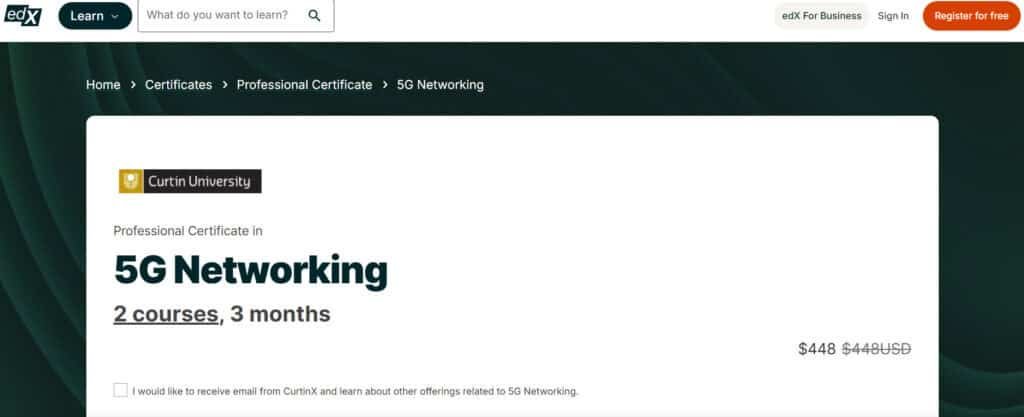
- Coursera & edX: Partner with top universities and companies (e.g., Arizona State University, Google, Ericsson) to offer structured specializations and professional certificates covering 5G fundamentals, applications, and specific technologies like Massive MIMO or edge computing.
- Udemy & Pluralsight: Provide a vast library of individual courses taught by industry experts, often focusing on practical skills and specific software tools relevant to 5G deployment and optimization.
- Vendor-Specific Academies: Companies like Nokia (Nokia Academy), Ericsson (Ericsson Educate), Huawei (Huawei ICT Academy), and Cisco (Cisco Networking Academy) offer their own certification programs and training paths. These are often highly specialized, focusing on their proprietary equipment and solutions, which can be invaluable if you plan to work with a specific vendor's technology.
- Industry Associations: Organizations like the GSMA, 3GPP, and IEEE often provide educational resources, webinars, and sometimes certification programs that cover broader industry trends and standards.
Types of Courses Available
Online 5G curricula vary significantly in depth and focus:
- Introductory Courses: Ideal for beginners, these cover 5G fundamentals, its evolution from previous generations, and its core benefits. They often touch upon spectrum management and basic network architecture.
- Specialized Technical Courses: Dive deep into specific aspects such as Radio Access Network (RAN) design and optimization, 5G Core Network (5GC) functions, network slicing implementation, beamforming techniques, or security protocols in 5G.
- Application-Focused Courses: Explore how 5G integrates with other technologies like IoT, Artificial Intelligence (AI), and cloud computing to enable specific use cases (e.g., smart city applications, industrial automation).
- Vendor-Specific Training: Focus on the configuration, deployment, and troubleshooting of 5G equipment and software from particular vendors. These are crucial for roles directly involved with hardware and software from companies like Ericsson, Nokia, or Huawei.
- Project-Based Learning: Some advanced courses incorporate virtual labs and simulations, allowing learners to gain hands-on experience with 5G network components and scenarios, reinforcing theoretical knowledge with practical application.
Key Aspects Covered in Comprehensive 5G Curricula
A robust 5G education should cover a range of foundational and advanced topics to provide a holistic understanding of the technology.
Foundational Concepts
- Wireless Communication Principles: A strong grasp of radio frequency (RF) basics, signal propagation, modulation, and multiple access techniques is essential before diving into 5G specifics.
- Evolution of Mobile Networks: Understanding the journey from 2G to 4G provides context for 5G’s innovations and design choices.
- Spectrum Management: Knowledge of how spectrum is allocated and utilized (e.g., sub-6 GHz, mmWave) is critical for network planning and optimization.
5G Network Architecture
This is the core of 5G understanding. Courses should detail:
- New Radio (NR): The air interface for 5G, including its physical layer and MAC layer operations.
- 5G Core (5GC): The redesigned, cloud-native infrastructure that supports enhanced services, network slicing, and efficient resource management.
- Massive MIMO and Beamforming: Key technologies that enable higher data rates and improved coverage by leveraging multiple antennas.
Advanced 5G Features and Use Cases
Beyond the basics, comprehensive courses explore 5G's distinct service categories:
- Enhanced Mobile Broadband (eMBB): Focusing on high-speed data for consumers.
- Ultra-Reliable Low-Latency Communication (URLLC): Critical for applications requiring immediate response times, like autonomous vehicles and industrial automation.
- Massive Machine Type Communications (mMTC): Designed for connecting billions of IoT devices efficiently.
- Network Slicing: The ability to create virtual, isolated network segments tailored to specific service requirements.
- Edge Computing: Bringing computation and data storage closer to the source of data generation to reduce latency and bandwidth usage.
Application and Integration
Understanding how 5G interacts with other emerging technologies is vital:
- IoT Integration: How 5G facilitates large-scale IoT deployments and specific IoT use cases.
- AI/ML in 5G Networks: The role of artificial intelligence and machine learning in optimizing network performance, predicting issues, and automating operations.
- Security Aspects: Addressing the unique security challenges and solutions within 5G networks to ensure data integrity and privacy.
Choosing the Right 5G Certification for Your Career Path
Certifications validate your skills and knowledge, making you a more attractive candidate in the competitive job market. While specific "5G certifications" are still emerging and evolving, many established telecom industry and networking certifications provide a strong foundation or specialize in 5G-related areas.
Industry-Recognized Certifications and Programs
- Vendor-Specific Certifications:
- Nokia: Offers certifications like "Nokia 5G Certification Program" which validate expertise across their 5G portfolio.
- Ericsson: Provides training and certifications through Ericsson Educate, covering 5G network deployment and operations.
- Huawei: Through the Huawei ICT Academy, offers certifications like HCIA-5G and HCIP-5G, focusing on their 5G solutions.
- General Networking Certifications (Foundational for 5G):
- CompTIA Network+: A foundational certification for anyone entering networking, providing core concepts relevant to all wireless technologies.
- Cisco CCNA/CCNP Service Provider: While not exclusively 5G, these certifications cover IP networking, routing, and switching, which are critical for understanding the underlying transport and core network of 5G.
- Emerging 5G-Specific Certifications: Look for programs from reputable training providers or industry consortia that explicitly offer "5G Certified Professional" or similar titles, often focusing on broader theoretical and architectural aspects rather than a single vendor's equipment.
Factors to Consider When Selecting a Certification
- Your Career Goals: Are you aiming for a role in RAN optimization, core network development, IoT solutions, or business strategy? Choose a certification that aligns directly with your desired career opportunities.
- Prerequisite Knowledge: Some advanced 5G courses and certifications require prior networking or telecommunications experience. Ensure you meet the prerequisites or are willing to complete foundational courses first.
- Course Depth and Hands-On Components: Evaluate if the program offers sufficient depth in the areas you need and if it includes virtual labs or practical exercises to gain hands-on experience.
- Instructor Expertise and Course Quality: Research the instructors' backgrounds and read reviews of the course content.
- Cost and Time Commitment: Online courses vary widely in price and duration. Balance your budget and available time with the value proposition of the certification.
- Industry Recognition: Prioritize certifications that are widely recognized and respected by employers in the telecom industry and related sectors.
Maximizing Your Online 5G Learning Experience
Enrolling in a course is just the first step. To truly benefit from your 5G online courses and certifications, adopt strategies that enhance retention and practical application.
Practical Tips for Success
- Set Clear Learning Goals: Define what you want to achieve from each course. Is it to understand network slicing, master RAN optimization, or prepare for a specific job role?
- Consistent Study Habits: Online learning requires discipline. Schedule dedicated study times and stick to them. Break down complex topics into manageable chunks.
- Utilize Virtual Labs and Simulations: Theory is important, but practical application is crucial. Make full use of any virtual labs or simulation environments provided to configure, troubleshoot, and experiment with 5G network components. This builds invaluable hands-on experience.
- Engage with the Community: Participate in discussion forums, Q&A sessions, and study groups. Networking with peers and instructors can deepen your understanding and open doors to new insights and career opportunities.
- Stay Updated with Industry Trends: The 5G landscape is dynamic. Follow industry news, read whitepapers, and attend webinars to keep abreast of the latest developments, standards, and use cases. This demonstrates proactive skill development.
- Apply Knowledge Through Personal Projects: If possible, work on small personal projects that leverage 5G concepts. This could involve exploring IoT device integration, simulating a private 5G network, or developing an edge application.
Building a 5G-Ready Portfolio
Beyond certifications, a portfolio showcasing your practical 5G skills can significantly boost your employability. Include:
- Completed Projects: Detail any virtual lab exercises, simulations, or personal projects you've undertaken, highlighting the 5G concepts applied and the outcomes achieved.
- Certificates of Completion: List all relevant 5G certifications and course completions.
- Contributions: Any participation in open-source 5G projects, relevant blogs, or presentations.
The Future Landscape: Beyond Basic 5G Skills
The journey with 5G doesn't end with current certifications. The technology is continuously evolving, with 5G-Advanced already on the horizon and 6G research gaining momentum. Future 5G professionals will need to understand the convergence of 5G with:
- Artificial Intelligence (AI) and Machine Learning (ML): For network automation, predictive analytics, and intelligent resource management.
- Edge Computing: As more processing moves closer to the data source, expertise in deploying and managing applications at the network edge will be vital.
- Cloud-Native Architectures: 5G networks are increasingly built on cloud infrastructure, demanding skills in cloud platforms (AWS, Azure, Google Cloud) and containerization technologies (Kubernetes, Docker).
- Cybersecurity: The expanded attack surface of 5G and IoT networks necessitates robust cybersecurity knowledge.
- Quantum Computing and Blockchain: While nascent, these technologies could play a role in future network security and efficiency.
Continuous skill development and adaptation will be key to long-term success in the telecom industry and the broader digital economy driven by advanced mobile communication systems.
Frequently Asked Questions About 5G Online Learning
What are the prerequisites for 5G online courses?
While introductory 5G courses often require no specific prerequisites beyond basic computer literacy, more advanced 5G online courses and certifications typically benefit from a foundational understanding of networking concepts (like TCP/IP, routing, switching), basic telecommunications principles, and sometimes even a grasp of Linux command line or basic programming. For highly specialized courses in RAN optimization or core network design, prior experience in cellular networks (e.g., 4G LTE) is often beneficial.
How long does it take to get 5G certified?
The time required to get 5G certified varies significantly depending on the certification program's depth, your existing knowledge, and the time you can dedicate to study. Introductory courses might take a few weeks (e.g., 20-40 hours of content). More comprehensive certification programs from vendors

0 Komentar