
Complete Guide
The landscape of scientific exploration is on the cusp of an unprecedented transformation, driven by the relentless advancement of artificial intelligence. By 2025, the future of AI-assisted scientific discovery will not be a mere theoretical concept but a tangible reality, fundamentally reshaping how breakthroughs are made, hypotheses are tested, and data-driven insights are extracted. This comprehensive guide delves into how intelligent systems are poised to amplify human ingenuity, accelerate research cycles, and unlock previously intractable problems across disciplines, from drug discovery to climate science. Prepare to explore the core technologies, transformative applications, and essential strategies for navigating this exciting new era where AI becomes an indispensable partner in the quest for knowledge.
The Dawn of AI-Accelerated Discovery: A 2025 Vision
In the rapidly approaching year of 2025, artificial intelligence will have firmly cemented its role as a pivotal catalyst in scientific advancement. We are moving beyond rudimentary data processing to sophisticated cognitive assistance, where AI systems can propose novel experiments, synthesize vast amounts of scientific literature, and even design molecules with specific properties. This isn't just about automation; it's about augmentation – empowering scientists with tools that transcend human cognitive limitations, allowing them to focus on high-level strategic thinking and creative problem-solving. The acceleration of research cycles, from initial hypothesis generation to validated discovery, will be one of the most profound impacts of this AI integration.
Redefining Research Paradigms
Traditional scientific methods, while foundational, often involve laborious, time-consuming processes. The sheer volume of data generated in modern research, from genomics to astrophysics, has surpassed human capacity for analysis. This is where AI steps in, offering a paradigm shift. Imagine a world where a biologist can leverage AI to predict protein folding with unprecedented accuracy, or a materials scientist can simulate millions of molecular combinations in minutes. This shift redefines what's possible, pushing the boundaries of scientific inquiry further and faster than ever before. The emphasis moves from brute-force experimentation to intelligent, data-informed exploration.
The Urgency of Adoption
Institutions and individual researchers who embrace AI early will gain a significant competitive advantage. The global scientific community is increasingly recognizing that AI is not an optional add-on but a critical infrastructure component. Governments and funding bodies are channeling significant investments into AI research and development for scientific applications, underscoring the urgency of adoption. By 2025, a significant portion of cutting-edge research will either be AI-driven or AI-assisted, making proficiency in these tools a new baseline for scientific excellence. Explore current AI in research trends.
Core AI Technologies Shaping Scientific Breakthroughs by 2025
The promise of AI in scientific discovery is underpinned by several key technological advancements, each contributing unique capabilities to the research workflow. Understanding these core technologies is crucial for appreciating the scope of their impact.
Machine Learning for Predictive Modeling and Pattern Recognition
- Deep Learning: Neural networks, particularly deep learning architectures, excel at identifying complex patterns in vast, unstructured datasets. In biology, this translates to predicting disease outcomes, identifying biomarkers, and understanding genetic predispositions. For physics, it means analyzing particle accelerator data or astronomical observations with unparalleled precision.
- Reinforcement Learning: This branch of machine learning in research is becoming invaluable for optimizing experimental parameters and designing autonomous research agents. Imagine an AI system learning to conduct and refine chemical reactions in a lab setting, continually improving its efficiency and yield.
- Predictive Analytics: Beyond pattern recognition, AI's ability to forecast outcomes based on historical data is transforming fields like climate modeling, epidemiological studies, and even financial forecasting within research institutions. This allows for proactive strategies and more efficient resource allocation.
Natural Language Processing (NLP) for Knowledge Extraction
The world's scientific knowledge is largely locked away in millions of research papers, patents, and reports. NLP, particularly advanced transformer models, is unlocking this treasure trove. By 2025, NLP tools will be far more sophisticated at:
- Automated Literature Review: Rapidly synthesizing information from thousands of papers, identifying key findings, contradictions, and gaps in existing knowledge. This drastically reduces the time scientists spend sifting through literature.
- Hypothesis Generation: NLP models can analyze connections between disparate scientific concepts, suggesting novel hypotheses or research directions that human researchers might overlook due to cognitive biases or limited scope.
- Patent Analysis: Extracting critical information from patent databases to identify emerging technologies, potential collaborators, or areas of high innovation.
Generative AI and Large Language Models (LLMs)
The advent of generative AI, including powerful Large Language Models (LLMs), is revolutionizing the creative and conceptual stages of research. These models can:
- Design Novel Materials: Generative adversarial networks (GANs) and other generative models are being used to design new molecules, proteins, and materials with desired properties, accelerating materials science innovation.
- Synthetic Data Generation: Creating realistic synthetic datasets for training other AI models, especially useful where real-world data is scarce or sensitive.
- Automated Report Generation: Assisting in drafting research papers, grant proposals, and summaries, freeing up scientists' time for actual research.
Robotics and Automated Experimentation
The integration of AI with robotics is leading to the rise of autonomous laboratories. By 2025, we will see:
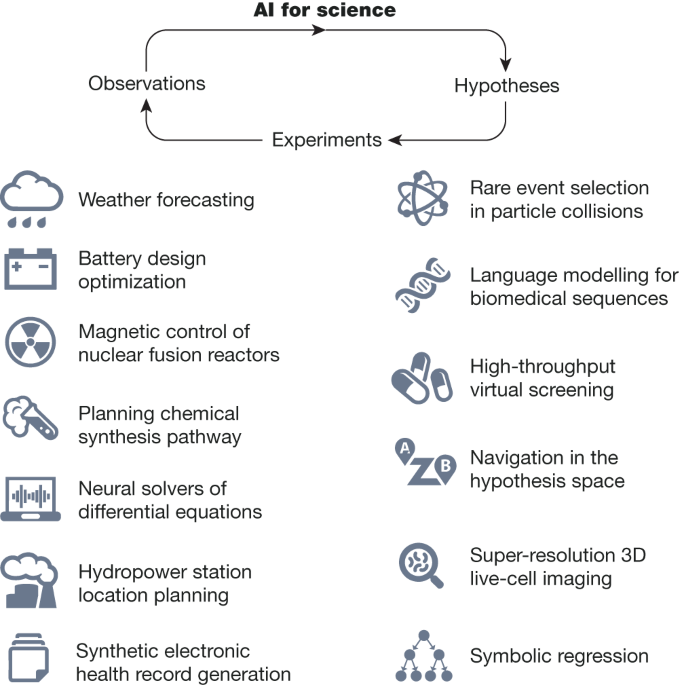
- Automated Experimentation Platforms: Robots capable of executing complex experiments, collecting data, and even making real-time adjustments based on AI analysis. This is particularly impactful in high-throughput screening for drug discovery.
- Self-Driving Labs: Fully automated systems that can perform experiments, analyze results, and iteratively design the next experiment without human intervention, dramatically speeding up the discovery process. These robotic labs represent a significant leap in efficiency.
Transformative Applications Across Scientific Disciplines
The impact of AI in scientific discovery is not confined to a single field but is broadly transformative, permeating nearly every scientific discipline.
Accelerating Drug Discovery and Personalized Medicine
One of the most immediate and impactful applications of AI is in healthcare and life sciences. AI is drastically reducing the time and cost associated with drug development. By 2025:
- Target Identification: AI will rapidly identify potential drug targets by analyzing genomic, proteomic, and clinical data.
- Molecule Synthesis & Optimization: AI will design novel molecular structures with desired therapeutic properties, predict their efficacy and toxicity, and optimize synthesis pathways, leading to faster drug discovery acceleration.
- Clinical Trial Optimization: AI will identify suitable patient cohorts, predict trial outcomes, and monitor patient responses, making clinical trials more efficient and successful.
- Personalized Medicine: AI will enable truly personalized treatment plans by analyzing individual patient data (genetics, lifestyle, medical history) to predict drug responses and tailor therapies for maximum efficacy and minimal side effects. This represents a significant step forward in patient care.
Revolutionizing Materials Science and Engineering
The discovery of new materials with specific properties is fundamental to technological progress. AI is accelerating this process:
- Predictive Material Design: AI models can predict the properties of hypothetical materials, allowing scientists to virtually screen millions of candidates before synthesizing them in the lab.
- Process Optimization: AI can optimize manufacturing processes for new materials, reducing waste and improving efficiency.
- Discovery of Novel Materials: AI is being used to discover entirely new classes of materials with unprecedented properties, from superconductors to advanced composites.
Advancing Climate Science and Environmental Research
Addressing global challenges like climate change requires sophisticated data analysis and predictive capabilities. AI is proving invaluable:
- Climate Modeling: AI enhances the accuracy and resolution of climate models, providing better predictions of future climate scenarios.
- Environmental Monitoring: AI analyzes satellite imagery and sensor data to monitor deforestation, pollution levels, and biodiversity changes with greater precision.
- Sustainable Solutions: AI assists in designing more efficient renewable energy systems and optimizing resource management for sustainability. This provides critical data-driven insights for policy makers.
Unlocking the Mysteries of Basic Science
Even in fundamental research, AI is opening new avenues:
- Particle Physics: AI helps analyze vast datasets from particle accelerators, identifying rare events and new particles.
- Astronomy: AI assists in classifying galaxies, detecting exoplanets, and analyzing complex astronomical data, leading to deeper cosmic understanding.
- Computational Biology: AI is driving breakthroughs in understanding complex biological systems, from protein interactions to neural networks. This area, often referred to as computational biology, is seeing exponential growth.
Navigating the Challenges and Ensuring Responsible AI Integration
While the potential of AI in scientific discovery is immense, its full realization requires addressing several critical challenges related to data, skills, and ethics.
Data Governance and Quality Assurance
AI models are only as good as the data they are trained on. Ensuring high-quality, unbiased, and well-curated datasets is paramount. By 2025, institutions will need robust data governance frameworks, including:
- Standardized Data Formats: Developing common standards for data collection and storage to facilitate AI model training and interoperability.
- Data Curation and Labeling: Investing in human expertise to meticulously clean, label, and validate scientific datasets, which is a labor-intensive but crucial step.
- Addressing Bias: Actively identifying and mitigating biases in datasets that could lead to flawed or discriminatory AI outcomes, particularly in medical research.
Bridging the Skills Gap
The scientific workforce needs to evolve. While AI will not replace scientists, it will transform their roles. By 2025, there will be an increasing demand for:
- AI-Literate Scientists: Researchers who understand AI's capabilities and limitations, and can effectively integrate AI tools into their workflows.
- Interdisciplinary Experts: Individuals with expertise in both a scientific domain (e.g., chemistry, biology) and AI/data science.
- Training Programs: Universities and research institutions must develop comprehensive training programs to upskill the existing workforce and prepare the next generation of scientists for an AI-first research environment.
Ethical AI Development and Bias Mitigation
The power of AI necessitates careful ethical consideration. Ensuring ethical AI development is critical to maintaining trust and preventing harm. Key concerns by 2025 include:
- Algorithmic Bias: Ensuring AI models do not perpetuate or amplify existing societal biases, especially in sensitive areas like medicine or social science research.
- Transparency and Explainability: Developing "explainable AI" (XAI) models that can justify their decisions, allowing scientists to understand why an AI made a particular prediction or recommendation.
- Data Privacy and Security: Protecting sensitive research data, especially patient information or proprietary scientific discoveries, from misuse or breaches.
The Indispensable Role of Human-AI Collaboration
The most successful scientific endeavors in the AI era will not be purely AI-driven but will thrive on robust human-AI collaboration. AI is a powerful tool, but human creativity, intuition, and ethical reasoning remain irreplaceable.
Augmenting Human Ingenuity, Not Replacing It
By 2025, AI will serve as an intelligent assistant, augmenting human capabilities. It will handle the tedious, data-intensive tasks, allowing scientists to:
- Focus on High-Level Thinking: Spend more time on creative problem-solving, designing novel experiments, and interpreting complex results.
- Explore Novel Hypotheses: Leverage AI's pattern recognition to identify connections and generate new research questions that might otherwise be missed.
- Validate and Iterate: Critically evaluate AI-generated insights, design experiments to validate them, and iterate on models based on real-world feedback.
Fostering Interdisciplinary Synergies
The complexity of modern scientific challenges often requires a multidisciplinary approach. AI acts as a bridge, facilitating collaboration between diverse fields:
- Data Scientists and Domain Experts: Closer collaboration between AI specialists and domain scientists (e.g., chemists, physicists, biologists) to ensure AI models are scientifically sound and relevant.
- Cross-Institutional Collaboration: AI platforms can facilitate sharing of data and models across institutions, accelerating collective progress on grand challenges like disease eradication or climate mitigation.
Actionable Strategies for Embracing the AI Future
To fully capitalize on the future of AI-assisted scientific discovery 2025, stakeholders across the scientific ecosystem must adopt proactive strategies.
For Researchers and Scientists
- Embrace AI Literacy: Dedicate time to understanding AI fundamentals, common algorithms, and available tools. Online courses, workshops, and internal training programs are invaluable.
- Identify AI-Applicable Problems: Look for areas in your research where data is abundant, patterns are complex, or automation could significantly boost efficiency.
- Collaborate with AI Experts: Seek partnerships with data scientists, machine learning engineers, and computational specialists. This interdisciplinary approach is key.
- Focus on Data Quality: Prioritize meticulous data collection, curation, and documentation to ensure your datasets are AI-ready.
- Maintain Critical Thinking: Always apply scientific rigor to AI-generated insights. AI is a tool, not an oracle.
For Research Institutions and Funders
- Invest in AI Infrastructure: Provide access to high-performance computing, cloud resources, and specialized AI platforms.
- Develop AI Training Programs: Integrate AI and data science into curricula for both undergraduate and postgraduate scientific education. Offer continuous professional development for existing faculty.
- Foster Interdisciplinary Hubs: Create environments that encourage collaboration between traditional scientific disciplines and AI/data science departments.
- Establish Data Governance Frameworks: Implement robust policies for data collection, storage, sharing, and security, ensuring ethical and responsible data practices.
- Incentivize AI Adoption: Provide grants, fellowships, and recognition for AI-driven research projects and for researchers who successfully integrate AI into their work.
For Technology Developers
- Build User-Friendly Tools: Develop AI platforms and software that are intuitive and accessible to scientists who may not have deep coding expertise.
- Focus on Explainability: Prioritize building explainable AI models that provide insights into their decision-making processes, crucial for scientific validation.
- Ensure Scalability: Design AI solutions that can handle the massive datasets generated in modern scientific research.
- Engage with Domain Experts: Collaborate closely with scientists from various fields to ensure AI tools address real-world research challenges and integrate seamlessly into scientific workflows.
- Prioritize Ethical Design: Embed ethical principles into the design and deployment of AI systems, particularly concerning bias, privacy, and accountability.
Frequently Asked Questions
What specific areas of scientific discovery will AI impact most by 2025?
By 2025, AI is poised to have the most profound impact on areas characterized by vast datasets, complex interactions, and the need for rapid iteration. This includes drug discovery acceleration, personalized medicine, materials science, climate modeling, and computational biology. AI will significantly shorten discovery cycles in these fields by automating data analysis, predicting outcomes, and generating novel hypotheses, leading to breakthroughs that would be far slower or impossible with traditional methods.
How can researchers prepare for an AI-assisted future?
Researchers can prepare by developing fundamental AI literacy, understanding core concepts like machine learning and natural language processing. Practical steps include attending workshops, taking online courses, and seeking collaborations with AI specialists. It's crucial to focus on robust data management practices, as high-quality data is the fuel for AI. Embracing a mindset of human-AI collaboration, where AI augments rather than replaces human intelligence, will be key.
What are the primary ethical concerns regarding AI in science by 2025?
By 2025, primary ethical concerns surrounding AI in science will revolve around algorithmic bias, data privacy, and transparency. Bias in training data can lead to skewed or discriminatory scientific findings, especially in medical research. Protecting sensitive research data, like patient genomic information, is paramount. Additionally, the "black box" nature of some AI models raises concerns about explainability – scientists need to understand why an AI made a particular prediction to validate its findings and ensure scientific integrity. Addressing these issues through responsible AI development and robust governance will be critical.
Will AI replace human scientists in the near future?
No, AI will not replace human scientists by 2025 or in the foreseeable future. Instead, AI will serve as an indispensable tool, augmenting human capabilities. AI excels at processing vast amounts of data, identifying patterns, and performing repetitive tasks, freeing up scientists to focus on higher-level activities like creative problem-solving, experimental design, critical interpretation of results, and formulating novel research questions. The future of scientific discovery is unequivocally one of human-AI collaboration, where human intuition and ethical reasoning guide AI's powerful analytical capabilities.
How can smaller research labs leverage AI advancements?
Smaller research labs can leverage AI advancements by focusing on accessible cloud-based AI platforms and open-source tools, which often require less upfront investment in infrastructure. Prioritizing collaborations with university AI departments or external data science consultants can provide access to expertise. Furthermore, focusing on specific, data-rich problems within their niche where AI can offer a significant advantage, such as optimizing a particular experimental protocol or analyzing existing public datasets, can yield substantial benefits without requiring extensive in-house AI development.

0 Komentar